Open water supply: how high can a fire pump draw water?
A fire pump draws water 10.33 m high in theory, about 7 m in practice. A Belgian circular allows 6 m. Which strainer, suction hose and fittings you need.
No fire pump draws water higher than 10.33 m: that is the water column which atmospheric pressure of 1.013 bar supports at sea level. In practice it is about 7 to 7.5 m. The Belgian ministerial circular of 14 October 1975 allows less: a geometric suction height of 6 m at most and a suction line of 10 m at most. Between a canal or pond and the nozzle you need a suction strainer, suction hoses, a pump, delivery hose and a dividing piece at the fire. A collecting piece is added when two lines feed one pump.
Why suction stops well before 10.33 m
Atmospheric pressure does the lifting. The primer of the pump takes the air out of the suction line, and the 1.013 bar resting on the water surface pushes the water up the hose. That pressure equals a water column of 10.33 m, so no amount of pump power takes water higher.
Part of that height is lost on the way. German fire service training reckons on 7 to 7.5 m at most. A French training course for pump operators (COD 1, version of 2013) names 8.5 m as the practical ceiling. It lists what reduces the theoretical height: about 0.5 m for friction in the suction hoses and the strainer, and 1.3 m when the water is at 50 °C. Leaking seals take more.
Height also costs flow. The federal technical sheet TF06 for the semi-heavy pumper (November 2006) quotes the supplier's maximum figures for the pump: 3400 l/min at 12 bar with a suction height of 0 m, and 2400 l/min at 12 bar with 3 m.
What the Belgian circular asks of an open-water point
The Belgian circular stops at 6 m. Section 3 of the ministerial circular of 14 October 1975 on water resources for firefighting (in Dutch) sets the conditions under which a canal, pond, river or reservoir counts as a supply for firefighting.
| Condition | Value in the circular |
|---|---|
| Geometric suction height | 6 m or less |
| Height of the pump's standing area above the water level | less than 5 m |
| Length of the suction line | 10 m or less |
| Distance from the pumping place to the place of the fire | at most 400 m |
| Quantity of water, in most cases | 120 m³ spread evenly over 2 hours, at 1000 l/min |
| Fixed suction pipe, where one is installed | inside diameter of 100 mm |
The circular asks for these values "under the most unfavourable circumstances", so with the water at its lowest, and wants the point accessible to fire pumps at all times.
The suction strainer keeps debris out and the water column in
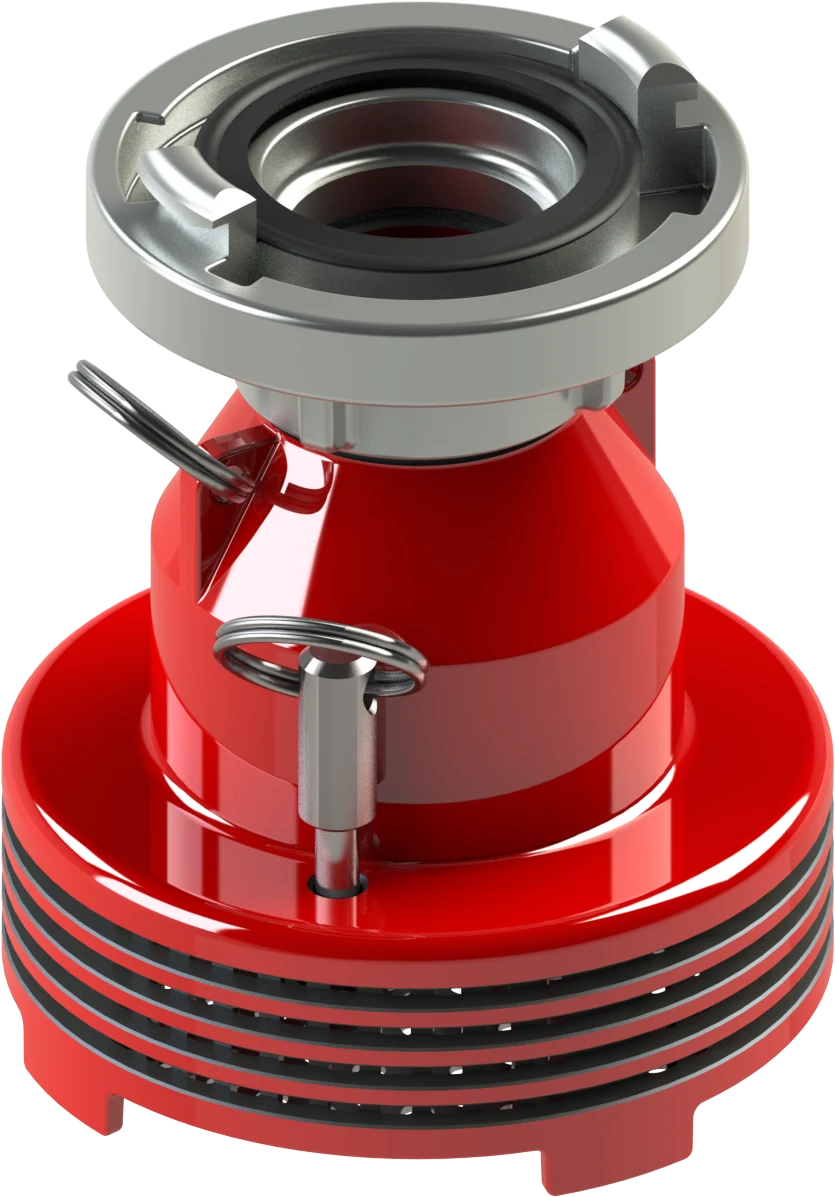
A suction strainer does two jobs. It keeps leaves, twigs and stones out of the pump and, if it has a non-return valve, it keeps the suction line full when the pump stops. Without the valve the water runs back as soon as pumping is interrupted, and the primer has to start again.
The federal sheet asks for one strainer per pumper: at most 7.5 kg, with a protective basket and a non-return valve with a draining device. That device is needed at the end of the job. The 12 m of 110 mm suction hose on the same sheet hold about 114 litres of water. A line that heavy comes out of the canal only after the valve has been lifted and the water has run back.
Place the strainer at least 30 cm under the surface and keep it off the bottom, away from mud and gravel. The French course gives the same figure. Sand and silt pass through any strainer.
Our suction strainers come in anodised aluminium, stainless steel or polypropylene, with or without a non-return valve, with DSP or Storz couplings. For a pump that draws by suction we recommend the valve, because a line that stays full does not have to be primed again after every interruption. Check the coupling of your suction hoses first. On a pumper built to the federal sheet they are 110 mm hoses with AR couplings. Couplings other than DSP and Storz are available on request.
Suction hoses: short, airtight and never on a hydrant
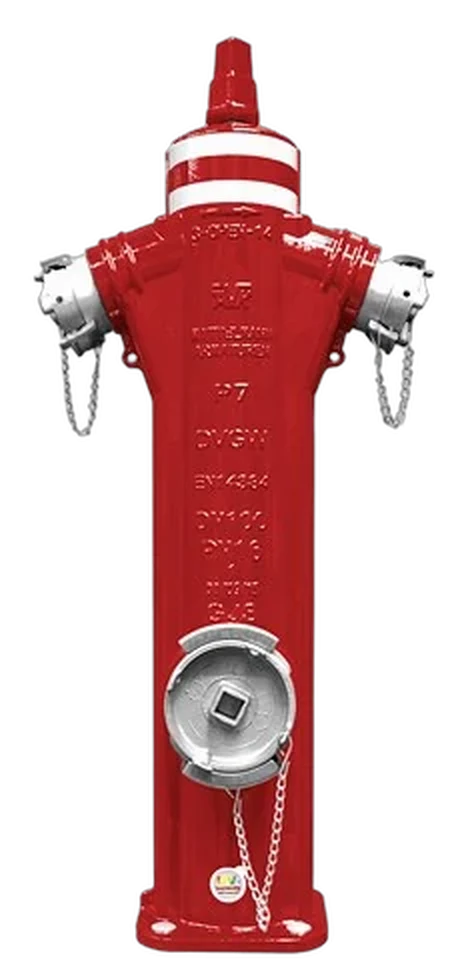
Suction hoses are for open water only. The ministerial circular of 9 March 1982 (in Dutch) forbids their use to feed a pump from an underground or above-ground hydrant, and writes the word in capitals. A hydrant delivers water under pressure and is connected with delivery hoses; our article on fire hydrants in Belgium covers that side.
Keep the suction line as short as the bank allows. Every metre adds friction on the side of the pump where about 1 bar is all you have.
If no water arrives within a minute of priming, stop and look for the cause; the French course sets the same limit. Usually air is getting in. Check these points:
- the seals of every coupling in the suction line are present and undamaged, and the couplings are tight
- the delivery valves and drain cocks of the pump are closed
- the strainer is fully under water and not blocked
- the hoses themselves are sound, with no porous wall and no lining that has come loose
A porous hose is better found in the workshop than at the canal. The German statutory accident insurance (DGUV Grundsatz 305-002, in German) asks for a visual, a vacuum and a pressure test at least every 12 months. A vacuum of 0.8 bar has to hold for at least one minute, and the hose then has to hold 3 bar for at least 5 minutes. The Belgian texts cited here set no interval. We suggest the German rule as the benchmark.
Let delivery hose cover the distance
Height lost on the suction side cannot be won back, but distance on the delivery side can. Stand the pump as low and as close to the water as the bank allows, and cover the way to the fire with delivery hose. The circular allows up to 400 m.
Over that distance the hose diameter decides. With the rule-of-thumb values from French fire service training tables, one 70 mm line carrying 1000 l/min loses about 2.2 bar per 100 m, so 8.8 bar over 400 m. Two 70 mm lines side by side, each carrying 500 l/min, lose 0.6 bar per 100 m, or 2.4 bar over the same distance. Our article on pressure loss in 45 and 70 mm hoses explains the figures.
Two lines need a collecting piece at the receiving pump, for instance a pumper near the fire that is fed by a portable pump at the canal. The collecting piece on the federal sheet is a 110/70+70: two DSP 70 inlets, an AR 110 coupling for the suction inlet of the pump and a non-return valve inside. With the valve, an unused inlet closes by itself. You can start on one line and add the second while water is flowing.
We supply the collecting piece with or without a non-return valve and recommend the valve for firefighting. Without it, both inlets have to be connected or the free one capped.
At the fire: a dividing piece with ball valves or screw valves
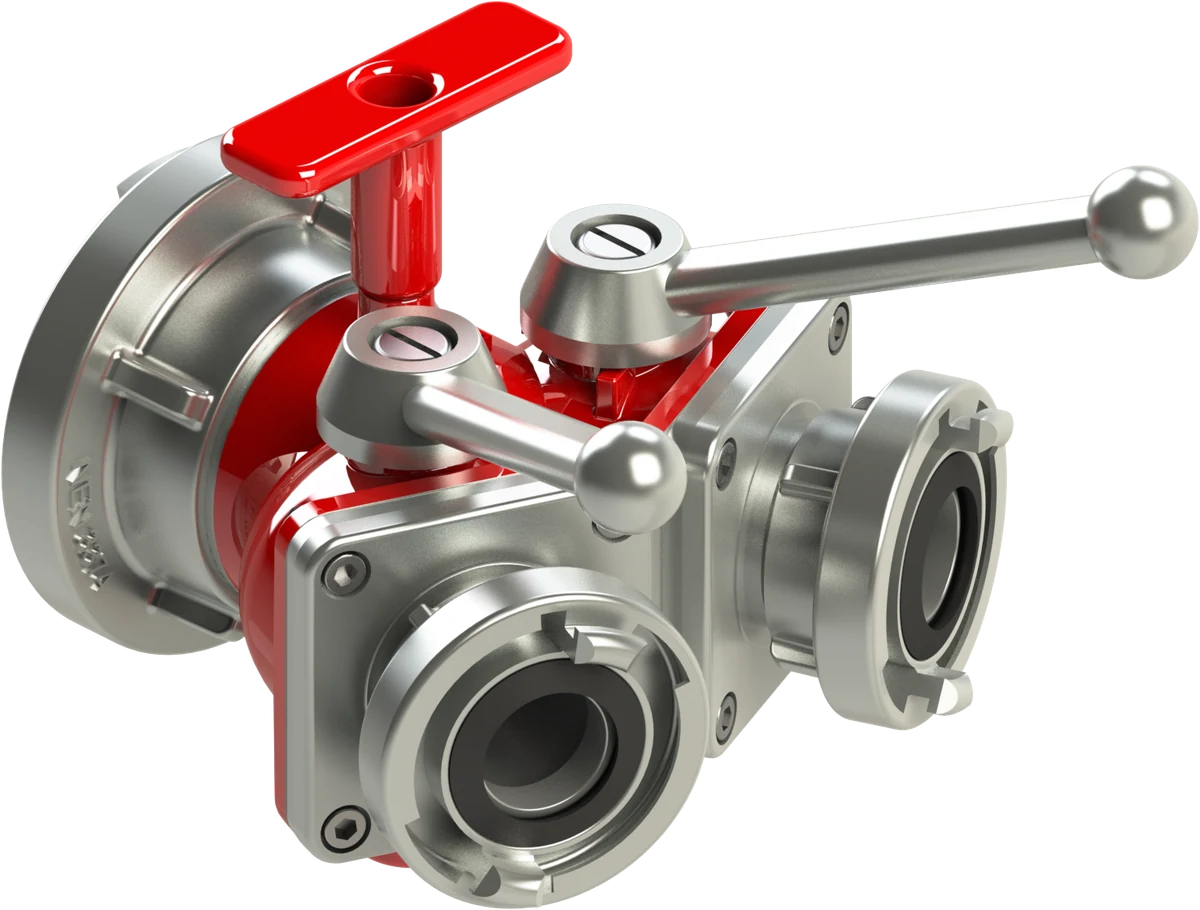
A dividing piece splits the supply line into attack lines and gives each outlet its own valve. The common Belgian layout has one 70 mm inlet and outlets of 70, 45 and 45 mm. The federal sheet lists three such dividing pieces per pumper, 70/70+45+45 to NBN 341, with DSP couplings.
The choice is in the valves. A ball valve opens and closes with a quarter turn, and the position of the lever shows whether the outlet is open. A screw valve takes several turns of the handwheel, so the flow comes on and goes off gradually.
That difference counts at the end of a long line. A sudden change of flow causes water hammer. The French course speaks of a pressure surge of the order of 10 to 12 bar that can burst hoses and damage pumps, and tells crews to operate every valve gently. With several hundred metres of moving water behind the dividing piece we would choose screw valves, which cannot be slammed shut. On short lines, ball valves are quicker to work and easier to read. Both versions come with DSP, Guillemin or Storz couplings, others on request.
Where open water falls short
Open water falls short where the bank is more than 5 m above the water, where the water is too shallow for the strainer or where the pumps cannot get near. The circular names remedies, among them a suction pit connected to water that is hard to reach and a fixed suction pipe. That pipe has a strainer at the submerged end and, at the other end, a symmetrical coupling closed by a blind cap on a small chain.
For a site with its own basin or pond we would take the fixed pipe. The strainer is already in the water and the crew only has to couple a suction hose.
Strainer, collecting piece and dividing piece all have to fit the couplings on your suction hoses, pump inlets and delivery hoses. Give their type and size when you ask for a quote through our contact page.
Frequently asked questions
How high can a fire pump lift water from open water?
In theory 10.33 m at sea level, the water column that atmospheric pressure supports. In practice the limit is about 7 to 7.5 m, and lower with warm water or leaking seals. The Belgian circular of 14 October 1975 allows a geometric suction height of 6 m at most.
What does a suction strainer do?
A suction strainer keeps leaves, twigs and stones out of the pump. A strainer with a non-return valve also holds the water in the suction line when the pump stops, so the pump does not have to prime again. It belongs at least 30 cm under the surface and clear of the bottom.
Can a suction hose be connected to a hydrant?
Not according to the Belgian ministerial circular of 9 March 1982, which forbids the use of suction hoses to feed a pump from an underground or above-ground hydrant. A hydrant is connected with delivery hoses.
What is the difference between a dividing piece and a collecting piece?
A dividing piece, or dividing breeching, splits one supply line into several lines, each with its own valve. The common Belgian layout is 70 mm in and 70, 45 and 45 mm out. A collecting piece, or collecting breeching, does the reverse: it joins two lines, for example two 70 mm lines, into the single large inlet of a pump.