Dry riser and wall hydrants: the rules in Belgium
A dry riser is an empty pipe the pumper fills. In high buildings the Belgian basic norms ask for a 70 mm riser and 2.5 bar at 500 l/min; outlets carry DSP.
A dry riser is an empty pipe fixed in a building, which the pumper fills through an inlet at ground level so that crews can connect their hose to a wall hydrant upstairs. The Belgian basic norms (Royal Decree of 7 July 1994) do not use the word dry: they describe a riser under permanent pressure. In buildings over 25 m it has an inside diameter of at least 70 mm and must leave 2.5 bar at the least favourable wall hydrant at 500 l/min. Dry or wet, the outlet carries the fire service coupling, which in Belgium is DSP.
Riser, wall hydrant and hose reel
A riser is fixed pipework that brings firefighting water to the upper floors. The legal terms are stijgleiding in Dutch and colonne montante in French, and the law adds neither "dry" nor "wet" to them.
A dry riser (droge stijgleiding, colonne sèche) stands empty. Luxembourg's fire and rescue corps CGDIS describes it in its Guide des moyens de secours (in French) as rigid fixed pipework that the fire appliances feed only during an intervention. A wet riser stays connected to a water supply and under pressure. The dry version cannot freeze and does not depend on the pressure in the building, but someone has to connect the pumper and fill the pipe first.
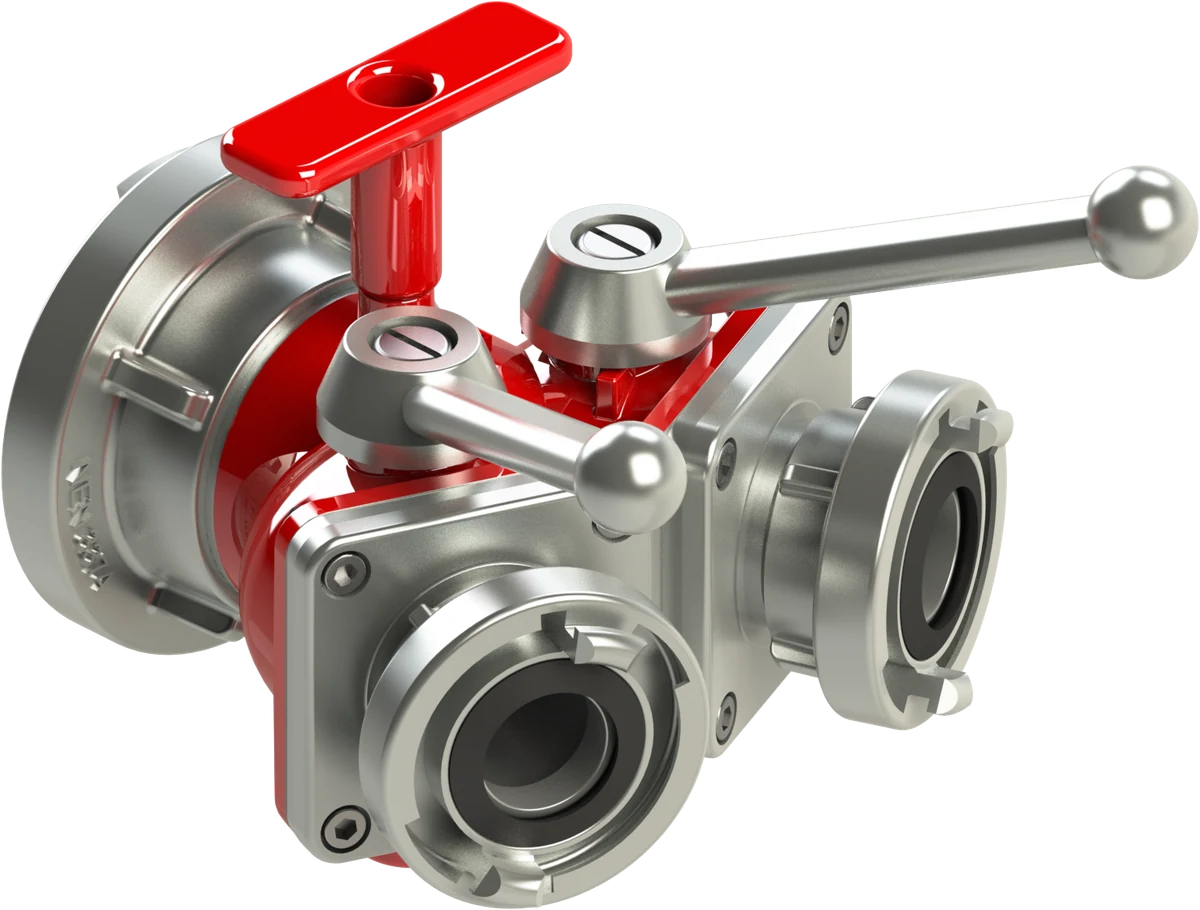
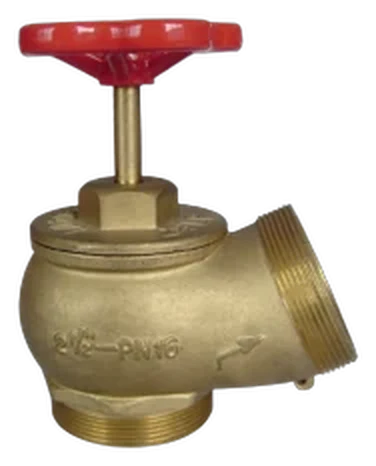
A wall hydrant (muurhydrant, hydrant mural; a landing valve in British usage) is the outlet on a floor: a valve with a handwheel and a delivery half coupling for fire service hose. It has no hose of its own.
A hose reel (muurhaspel or brandhaspel, dévidoir mural) does: a semi-rigid hose with a nozzle, permanently connected to the water supply. The scope of EN 671-1 says it is "for use by the occupants", and the basic norms call it first-intervention equipment, meant "voor gebruik door bewoners". The wall hydrant is not on that list.
What the basic norms require of risers and wall hydrants
Point 6.8.5.3 of the basic norms (Dutch text) covers hose reels and wall hydrants, and its demands rise with the height of the building. The figures come from annexes 2/1, 3/1 and 4/1, for buildings whose building application was filed from 1 December 2012.
| Building height (m) | Riser inside diameter | Pressure (bar) | Water to deliver |
|---|---|---|---|
| Under 10 (low) and 10 to 25 (medium) | sized so that the least favourable hose reel meets NBN EN 671-1 | at least 2.5 at the least favourable point | three hose reels at once for 30 minutes |
| Over 25 (high) | at least 70 mm | at least 2.5 left at the least favourable wall hydrant | 500 l/min from that hydrant, without hose or nozzle, and 30 m³/h for at least 2 hours |
The 30 m³/h is the same 500 l/min, kept up for two hours. In all three annexes the devices are fed with water under pressure "zonder voorafgaande bediening", without anyone having to operate anything first. That is a wet riser.
The number of wall hydrants is left more open. Number and place follow "de aard en de omvang van het brandgevaar", the nature and size of the fire risk, and the current annexes speak of "eventuele muurhydranten" (wall hydrants, if any). A building of less than 500 m² needs no hose reel, special risks excepted.
Point 6.8.5.4 covers the hydrants outside, which sit on a main of at least 80 mm inside diameter. Their types and signs are described under fire hydrants in Belgium.
Where the dry riser fits in
The basic norms say nothing about the dry riser. Article 1 also leaves existing buildings out: high and medium-rise buildings with a building application from before 26 May 1995, and low buildings from before 1 January 1998. Dry risers are found in Belgian buildings all the same. A ministerial circular of 9 March 1982 (in Dutch) names "de droge en natte kolommen van de gebouwen", the dry and wet risers of buildings, among the installations that must carry type couplings. What applies to your building is for the prevention service of your fire zone to say. This article quotes the texts and is not legal advice.
In use, a dry riser differs on one point. The pump operator sets the pressure, so a weak supply in the building is not the limit. Before the pipe is charged, someone checks that the valves on the other floors are closed, because an open valve lets the water out on the wrong floor.
A DSP coupling on every outlet
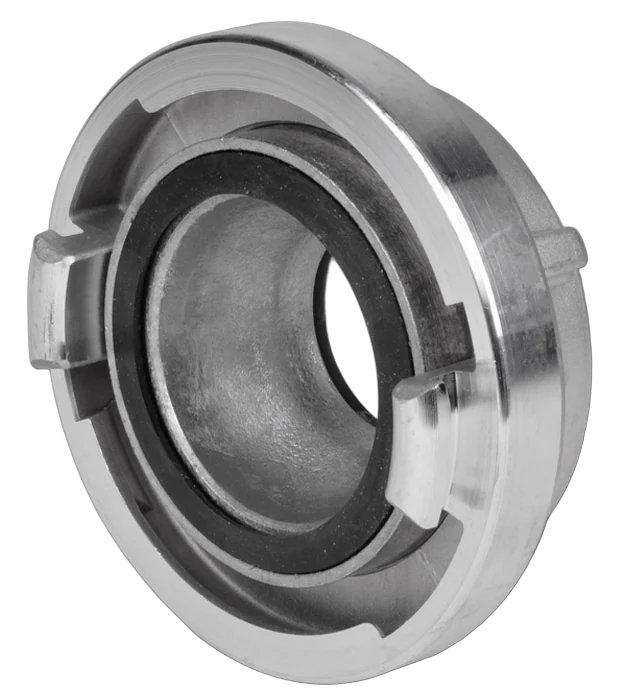
The delivery half coupling of a wall hydrant has to match the hose of the fire service. The older annexes of the basic norms refer to the Royal Decree of 30 January 1975 on type couplings. The current ones require a coupling "aangepast aan de koppelingen gebruikt door de brandweer", adapted to the couplings the fire service uses. In practice both mean DSP, because Belgian fire services run their 45 and 70 mm delivery hose on the symmetrical coupling of annex 1 of that decree.
Annex 1 gives the coupling in nominal sizes 45 and 70, with or without a locking ring, on a male or female threaded tail. The thread is G 1 1/2 or G 2 for size 45 and G 2 1/2 for size 70. Our brass landing valves come in the same three sizes: 1 1/2, 2 and 2 1/2 inch. The standard material in the annex is an anodised aluminium alloy; copper or stainless alloys are by agreement with the manufacturer. Threaded couplings, reducers and blind caps are in our DSP range.
Luxembourg does it differently. CGDIS specifies a twin inlet with Storz B couplings to DIN 14462 on a dry riser and Storz C couplings (42 mm) on every floor. A Belgian line with DSP 45 does not connect to that without an adapter, so order per country.
Working from a riser on 2.5 bar
The legal minimum of 2.5 bar at 500 l/min limits what a crew can do with a 45 mm line. Fire officer Karel Lambert of CFBT-BE works this out in his 2018 article "De stijgleiding". With Paul Grimwood's rule of thumb of 5 l/min per m² of burning floor, 500 l/min is enough to attack a fire of about 100 m². Lambert finds that acceptable for most apartment buildings and too little for large open-plan offices. Several Belgian brigades, he notes, chose a nozzle that still throws a usable jet below 4 bar.
Hose friction takes its share of that pressure. French fire service training reckons 1.5 bar per 100 m for 45 mm hose at 250 l/min and 6 bar per 100 m at 500 l/min. With 2.5 bar at the outlet, two 20 m lengths cost 0.6 bar at 250 l/min, and about 1.9 bar reaches the nozzle. At 500 l/min the same 40 m take 2.4 bar, almost all of the 2.5 bar. A 70 mm hose loses 0.6 bar per 100 m at that flow. Every 10 m of height costs another bar. These are rules of thumb; the tables are in our article on friction loss in 45 and 70 mm hose.
Two choices follow for the equipment. Pick a nozzle that works at low pressure: our Legende 500 regulates pressure and flow automatically and is operational from 2 bar. The article on how to choose a fire nozzle goes further into that. And where the fire zone leaves the outlet size open, we would fit the 2 1/2 inch valve with DSP 70 and keep a 70/45 reducer with it. A crew can then bring 70 mm hose to the door of the compartment and still connect a 45 mm line directly.
When the riser falls short, the hose goes up the stairs. Lambert describes the "mobile riser" of the Brussels fire service: 70 mm hose laid in the stairwell from cassettes of 40 m, one cassette for every four floors.
What to settle before you order valves and couplings
Four things have to be known before wall hydrants are ordered.
- The thread on the riser branch and the size of the valve. Our landing valves are brass, have a 30° angle and come in 1 1/2, 2 and 2 1/2 inch.
- The coupling on the outlet: DSP 45 or DSP 70, with or without a locking ring, as the fire zone or the specification asks.
- A blind cap for every outlet and for the inlet of a dry riser, to keep dirt out of the coupling.
- Hose and nozzle, if your own fire team will use the hydrants. Lay-flat hose for fixed systems falls under EN 14540 (inside diameter 25 to 52 mm, working pressure up to 15 bar); 45 and 70 mm delivery hose is with our fire hoses.
With the thread size of the riser branches, the coupling your fire zone asks for and the number of outlets, we can put together valves, couplings and caps.
Frequently asked questions
What is the difference between a dry riser and a wet riser?
A dry riser is empty until the fire service connects a pumper to the inlet at ground level and fills it. A wet riser is permanently connected to a water supply and under pressure. The Belgian basic norms describe the second kind, with at least 2.5 bar at the least favourable point.
Is a dry riser mandatory in Belgium?
The basic norms (Royal Decree of 7 July 1994) do not mention the dry riser. For buildings over 25 m they require a riser under pressure with an inside diameter of at least 70 mm and 2.5 bar left at the least favourable wall hydrant at 500 l/min. Whether a dry riser is required or accepted in a given building is a question for the prevention service of the fire zone.
Which coupling goes on a wall hydrant in Belgium?
A DSP coupling, the symmetrical delivery coupling from annex 1 of the Royal Decree of 30 January 1975, in size 45 or 70. The decree gives thread G 1 1/2 or G 2 for size 45 and G 2 1/2 for size 70. Luxembourg specifies Storz C on the floors and Storz B on the inlet.
What is the difference between a wall hydrant and a hose reel?
A hose reel has its own semi-rigid hose and nozzle and, under EN 671-1, is for use by the occupants. A wall hydrant is only a valve with a fire service coupling, to which the fire service or a trained fire team connects its own 45 or 70 mm hose.