Fire hose friction loss per 100 m: 45 mm or 70 mm
At 500 l/min a 45 mm fire hose loses about 6 bar per 100 m, a 70 mm hose 0.6 bar. Rule-of-thumb tables, the square law and a worked example.
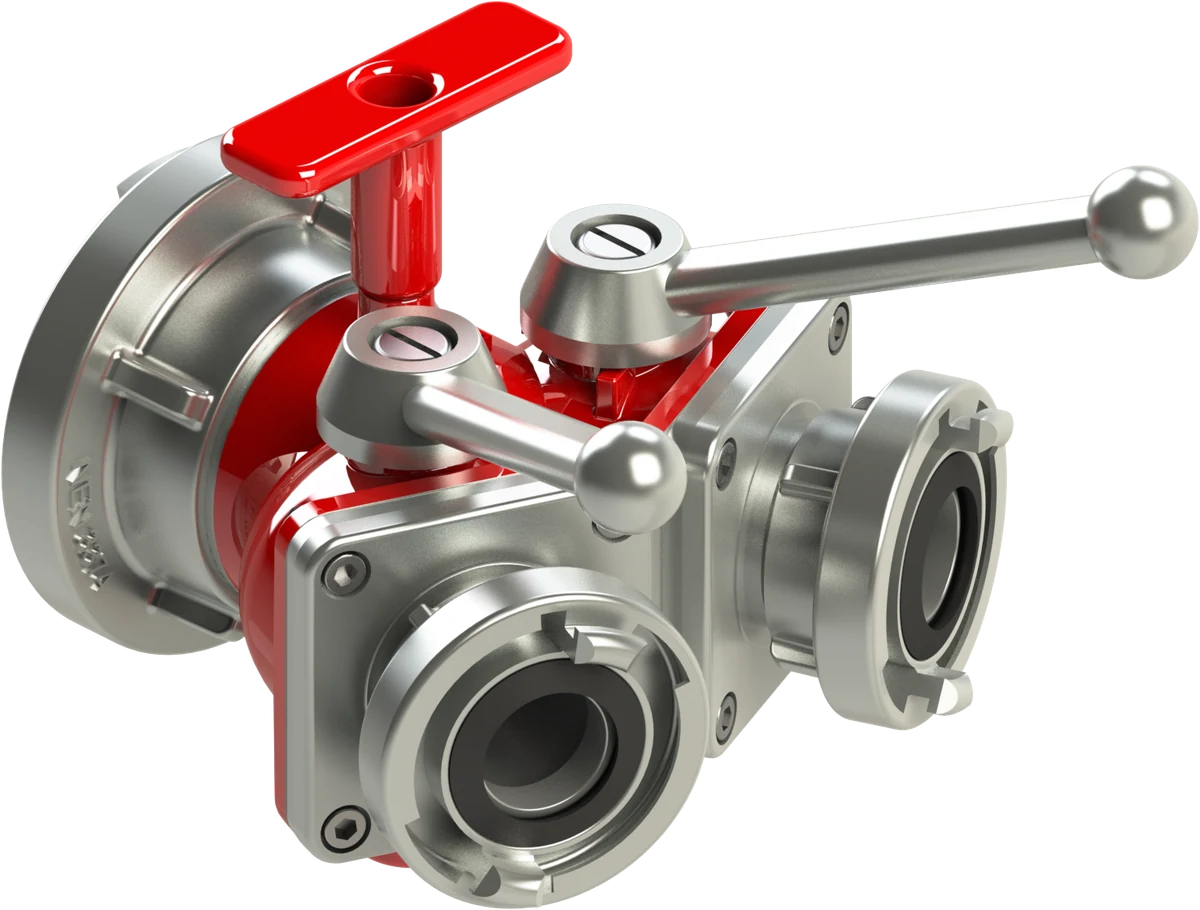
As a rule of thumb, a 45 mm fire hose loses 1.5 bar per 100 m at 250 l/min and 6 bar per 100 m at 500 l/min. A 70 mm hose loses 0.6 bar per 100 m at 500 l/min, a tenth of what the 45 mm hose loses at that flow. That is why 70 mm goes from the pump to the dividing piece, and 45 mm only on the last 20 to 40 m to the nozzle. These figures come from French and Luxembourg fire service training tables; the loss in your own hose depends on its make and lining.
Rule-of-thumb values per 100 m
French fire services lay the same 45, 70 and 110 mm diameters as Belgian ones. Their training gives each diameter one nominal flow: 250 l/min for 45 mm, 500 l/min for 70 mm and 1000 l/min for 110 mm. A pocket card from French fire service training lists the friction loss at that flow and at twice that flow.
| Hose diameter | Flow (l/min) | Friction loss (bar per 100 m) |
|---|---|---|
| 45 mm | 250 | 1.5 |
| 45 mm | 500 | 6 |
| 70 mm | 500 | 0.6 |
| 70 mm | 1000 | 2.2 |
| 110 mm | 1000 | 0.3 |
| 110 mm | 2000 | 1.12 |
French crews are taught not to exceed the nominal flow of a hose unless ordered to.
Luxembourg's fire and rescue corps CGDIS teaches the values for the Storz hose sizes used in Luxembourg and Germany. Dutch brigades use 52 and 75 mm hose too. The CGDIS training handout on water supply (in German) gives pump operators two figures to remember. A B hose (75 mm) loses 1.7 bar per 100 m at 1000 l/min, an A hose (110 mm) 1 bar per 100 m at 2000 l/min. It names 800 l/min as the best flow for a B hose.
| Storz hose size | Flow (l/min) | Friction loss (bar per 100 m) |
|---|---|---|
| C 42 | 200 | 2.3 |
| C 42 | 400 | 8.8 |
| C 52 | 200 | 0.6 |
| C 52 | 400 | 2.0 |
| C 52 | 800 | 8.5 |
| B 75 | 400 | 0.3 |
| B 75 | 800 | 1.1 |
| B 75 | 1000 | 1.7 |
| B 75 | 2000 | 7.0 |
| A 110 | 1000 | 0.3 |
| A 110 | 2000 | 1.0 |
Where 45 mm stops and 70 mm takes over
Use 45 mm for the part of the line that the crew has to move, and 70 mm for the distance. Belgian fire services work with these two diameters, usually joined by a three-way dividing piece. Fire officer Karel Lambert of CFBT-BE describes the practice in his 2016 article on high pressure: 70 mm hose covers most of the way from the pumper to the fire to limit the pressure loss. A 45 mm nozzle, he writes, flows 400 to 500 l/min, well above the French nominal flow. Every 20 m length of 45 mm then costs about 0.8 to 1.2 bar.
Our advice follows from the table. Lay 70 mm up to the dividing piece and keep the 45 mm attack line to 20 or 40 m. Any flow above 500 l/min goes through 70 mm. If the line has to grow, add the lengths on the 70 mm side: at 500 l/min an extra 20 m costs 0.12 bar there, against 1.2 bar in 45 mm. Our dividing pieces come with ball valves or screw valves and with DSP, Guillemin or Storz couplings.
A 45 mm line straight from the pump is enough for a short line at a modest flow. Sixty metres at 250 l/min lose 0.9 bar. A charged 70 mm hose is heavier and harder to handle, so it gains you nothing where the table shows less than one bar of loss.
Above 1000 l/min the 70 mm hose reaches its own limit. A monitor set to 2000 l/min can be fed through one 110 mm line at 1.12 bar per 100 m. The alternative is two 70 mm lines side by side, each carrying 1000 l/min at 2.2 bar per 100 m. A single B 75 hose would lose 7 bar per 100 m at 2000 l/min according to the CGDIS table. Our article on portable and fixed monitors covers what a monitor asks of the water supply.
Why twice the flow costs four times the pressure
Friction loss grows with the square of the flow. The hydraulics memento of the French fire service SDIS 26 puts it in one line: "Les pertes de charge sont proportionnelles au carré du débit" (pressure losses are proportional to the square of the flow). Double the flow and the loss is multiplied by four. Halve it and a quarter remains.
That gives the formula for any flow that is not in the table: loss per 100 m = loss at nominal flow × (flow ÷ nominal flow)². For a 45 mm hose at 400 l/min: 1.5 × (400 ÷ 250)² = 1.5 × 2.56 = 3.8 bar per 100 m. The Luxembourg table brackets that result: at 400 l/min a C 52 hose loses 2.0 bar and a C 42 hose 8.8 bar.
French pump operator training adds four rules. The loss is proportional to the length of the line, so 40 m costs 0.4 times the value per 100 m. For the same flow, a smaller diameter loses more. A rougher lining loses more. And the loss does not depend on the pressure in the hose: only the flow counts.
Height and the pressure at the end of the line
Every 10 m of climb costs 1 bar, and every 10 m of descent gives 1 bar back. The French and the Luxembourg training material agree on this. The French pocket card allows 3 m per storey, which makes 0.3 bar per floor.
The pump also has to supply what the appliance at the end of the line needs. French training sets 6 bar at adjustable-flow nozzles. The standard EN 15182-2 covers combination nozzles up to 1000 l/min at a reference pressure of 6 bar. Flow and pressure per nozzle type are covered in how to choose a fire nozzle.
CGDIS teaches 5 to 6 bar for a combination nozzle (the German Hohlstrahlrohr) and 5 bar for a foam nozzle. A water curtain needs 5 to 8 bar, an inline inductor 7 bar at its inlet. The French card asks for 10 bar at the inductor, plus the hose loss. Where the two countries differ, the data sheet of your own nozzle or inductor decides.
A complete line, step by step
Take a line laid the Belgian way: 100 m of 70 mm from the pumper to the dividing piece, then 40 m of 45 mm. The nozzle is on the second floor, 6 m above the pump. It is set to 500 l/min and needs 6 bar.
- Pressure at the nozzle: 6 bar.
- Attack line, 40 m of 45 mm at 500 l/min: 0.4 × 6 = 2.4 bar.
- Height, two storeys of 3 m: 0.6 bar.
- Supply line, 100 m of 70 mm at 500 l/min: 1.0 × 0.6 = 0.6 bar.
- Pressure at the pump: 6 + 2.4 + 0.6 + 0.6 = 9.6 bar.
Now a second crew opens an identical line on the same dividing piece. The 70 mm hose carries 1000 l/min and loses 2.2 bar instead of 0.6 bar, so the pump has to deliver 11.2 bar. The French pump operator course explains how to treat the dividing piece: the flow is shared there, while the pressure is the same at every outlet. You calculate along one line, the one that needs the most pressure.
Lay the same 100 m in 45 mm and that section alone costs 6 bar. One line then needs 15 bar at the pump, just under the 16 bar working pressure that DIN 14811 gives delivery hoses up to 75 mm. The 70 mm hose covers the same distance for 0.6 bar.
What these values do not tell you
The figures above are training values, and we have not measured them on the hoses we sell. The loss in a real hose depends on its make and its lining. Even the standard has been corrected: amendment A3 to DIN 14811, of December 2018, changed the pressure-loss values for the C 42 hose because the earlier ones were unrealistically low.
The sources also disagree in places. The pocket card gives 2.2 bar per 100 m for 70 mm at 1000 l/min, while the square law applied to the nominal value gives 2.4 bar. The SDIS 26 memento states that its tables leave out the local losses, those in couplings and fittings such as the dividing piece.
Read the result as an estimate and keep a margin. For a proposal of diameters and lengths from our range of fire hoses, send us the flow of your nozzles, the distances you have to cover and your coupling system. For the hose types themselves, see how to choose a fire hose.
Frequently asked questions
How much pressure does a 45 mm fire hose lose per 100 m?
As a rule of thumb from French fire service training: 1.5 bar per 100 m at 250 l/min and 6 bar per 100 m at 500 l/min. A 20 m length at 500 l/min therefore costs 1.2 bar. The exact loss depends on the make and lining of the hose.
When do you need a 70 mm hose instead of 45 mm?
For the distance between the pump and the dividing piece, and for any flow above 500 l/min. At 500 l/min a 70 mm hose loses 0.6 bar per 100 m, a 45 mm hose 6 bar. Keep the 45 mm attack line to the last 20 to 40 m.
How do you calculate friction loss at a flow that is not in the table?
Multiply the loss at the nominal flow by the square of the flow ratio. For a 45 mm hose at 400 l/min: 1.5 bar × (400 ÷ 250)² = 3.8 bar per 100 m. Then multiply by the length of the line in hundreds of metres.
How much pressure does height cost?
One bar per 10 m of climb, on top of the friction loss, and a line that runs downhill gains 1 bar per 10 m. French fire service training allows 3 m per storey, so each floor costs about 0.3 bar.