Water curtains: what they shield and what they do not
In a Dutch test a wall behind a vertical water curtain still heated up by 130 °C, against 180 °C without. Kept wet, it rose 25 °C. Flows, pressure, placement.
A water curtain stops part of the radiant heat of a fire, not all of it. In a test by the Dutch fire academy in 2015, a steel wall 3 m from the fire heated up by about 180 °C without a curtain and by about 130 °C behind a vertical one. When the wall itself was kept wet as well, the rise was about 25 °C. The curtain should therefore wet what you want to protect. Allow for 5 to 8 bar at the device and 300 to 1800 l/min, depending on the type.
What the Dutch test of 2015 measured
These figures come from the Brandweeracademie of the Dutch Instituut Fysieke Veiligheid, today NIPV. Its report Defensieve buiteninzet: warmtestraling en waterschermen (in Dutch) of 26 November 2015 describes nine experiments in a hangar, three for each set-up. Burning pallets in an opened shipping container heated its steel back wall to a peak of 676 °C on average. A thin steel sheet 3 m away stood in for the neighbouring building, and the water curtain was placed halfway between the two.
| Set-up | Highest temperature of the exposed sheet (°C) | Temperature rise (°C) |
|---|---|---|
| No water curtain | 188 to 226 | about 180 |
| Vertical water curtain | 151 to 160 | about 130 |
| Vertical water curtain, sheet kept wet | 44 to 52 | about 25 |
Without a curtain the sheet received 7 to 11 kW/m². In the trial runs one of the wooden beams that held the sheet caught fire at a measured 13.8 kW/m², so fire spread at this distance was a real prospect. The vertical curtain stopped a little more than half of the radiation, around 55 %.
The third set-up says most about practice. The researchers wanted to tilt the curtain so that its water would run down the exposed wall, but the hangar wall could not take that much water. They left the curtain upright and let 13 l/min run over the sheet of 2 m by 1 m from a small gutter. That film took up the radiation the curtain had let through. The report concludes that a set-up which also keeps the exposed wall wet works best and deserves preference wherever it is possible.
How a water curtain nozzle works
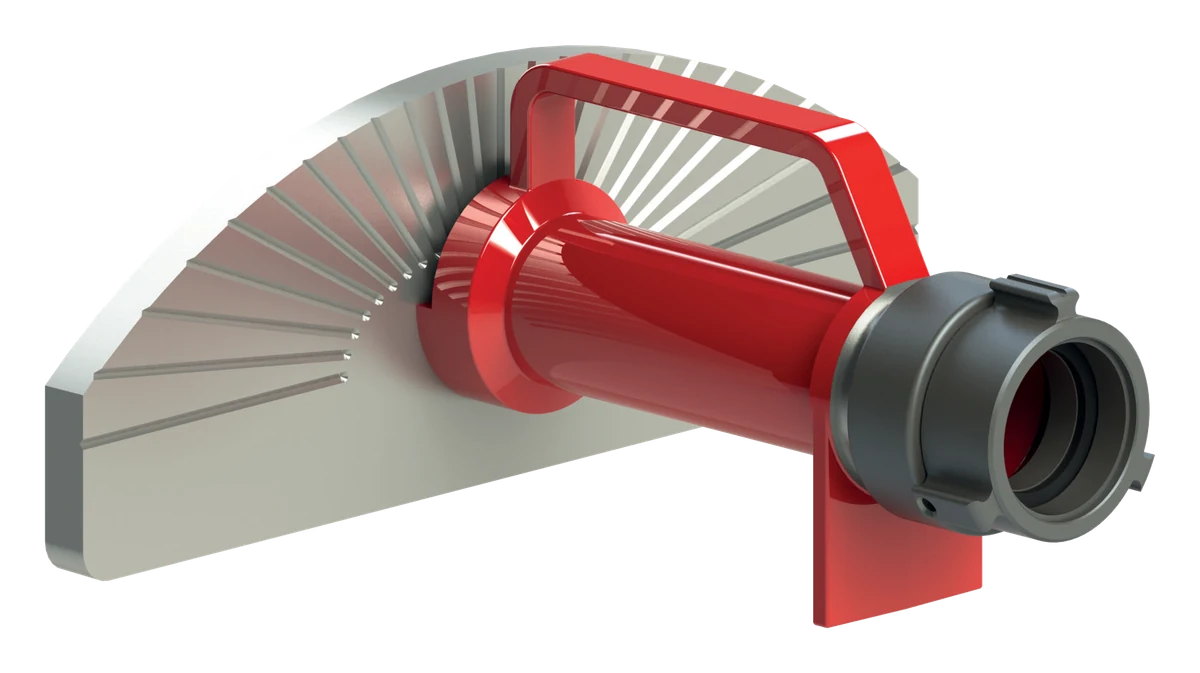
A water curtain nozzle is a short pipe with a hose coupling at one end and a half-round deflector plate at the other. The water hits the plate at a right angle and spreads into an upright fan. The device lies on the ground and needs no operator.
Liquid water absorbs infrared radiation well. The report places the heat radiation of flames mainly at wavelengths of 2 to 3 µm, a range that water takes up strongly. The weak point is the shape of the curtain. Close to the plate the water forms a closed film. Further out it breaks up into droplets, and radiation passes between them.
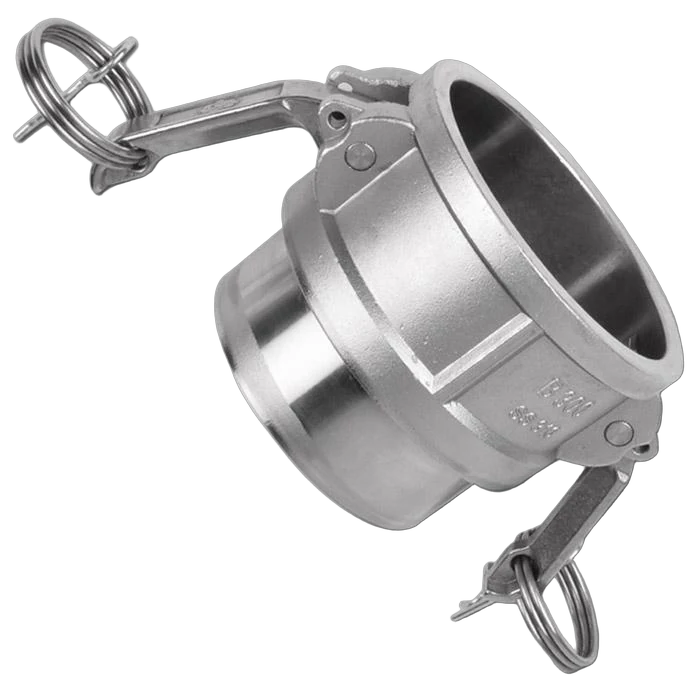
The name changes with the country. German and Dutch fire services say Hydroschild or hydroschild, in France the device is a "lance queue de paon" (peacock tail) or "lance écran". Our aluminium water curtains flow 300 to 1800 l/min depending on the type and have DSP or Storz couplings; other couplings are available on request.
Flow and pressure: 5 to 8 bar and a lot of water
A water curtain needs 5 to 8 bar at its inlet. That is the figure the Luxembourg fire and rescue corps CGDIS gives in its training handout on water supply (in German). With less pressure the curtain shrinks: in the Dutch test the device ran at 2 bar, used about 200 l/min and made a curtain about 11 m wide and 3.4 m high.
For the German types C and B, the German-language Wikipedia article on the Hydroschild lists the values below. Read them as a rule of thumb: they are not data sheet values of our curtains.
| Type | Pressure (bar) | Flow (l/min) | Curtain height (m) | Curtain width (m) |
|---|---|---|---|---|
| C | 5 | 800 | 6 | 24 |
| C | 8 | 1100 | 8 | 27 |
| B | 5 | 1400 | 7 | 27 |
| B | 8 | 1800 | 10 | 31 |
Set these flows against your supply. The Belgian ministerial circular of 14 October 1975 (in Dutch) takes 120 m³ of water spread evenly over two hours, a flow of 1000 l/min, as sufficient for firefighting in most cases. One large curtain uses that whole flow, or more.
The hose line takes its share too. French fire service training tables give a loss of 2.2 bar per 100 m of 70 mm hose at 1000 l/min. For 6 bar at the curtain the pump then has to deliver about 8.2 bar on level ground. For 45 mm hose the same tables give 6 bar per 100 m at 500 l/min, so a 45 mm line feeds the small types only, and over short distances. Our article on pressure loss in 45 and 70 mm hose has the full table.
Where to place it
Place the curtain between the fire and the object, and aim it so that its water reaches the surface you want to keep cool. Three practical points follow from the test and from the way the device works.
- Put the object behind the middle of the curtain. The film is closed near the plate and open towards the edges.
- Watch the surface you protect. If it stays dry, move the curtain closer or turn it towards the wall.
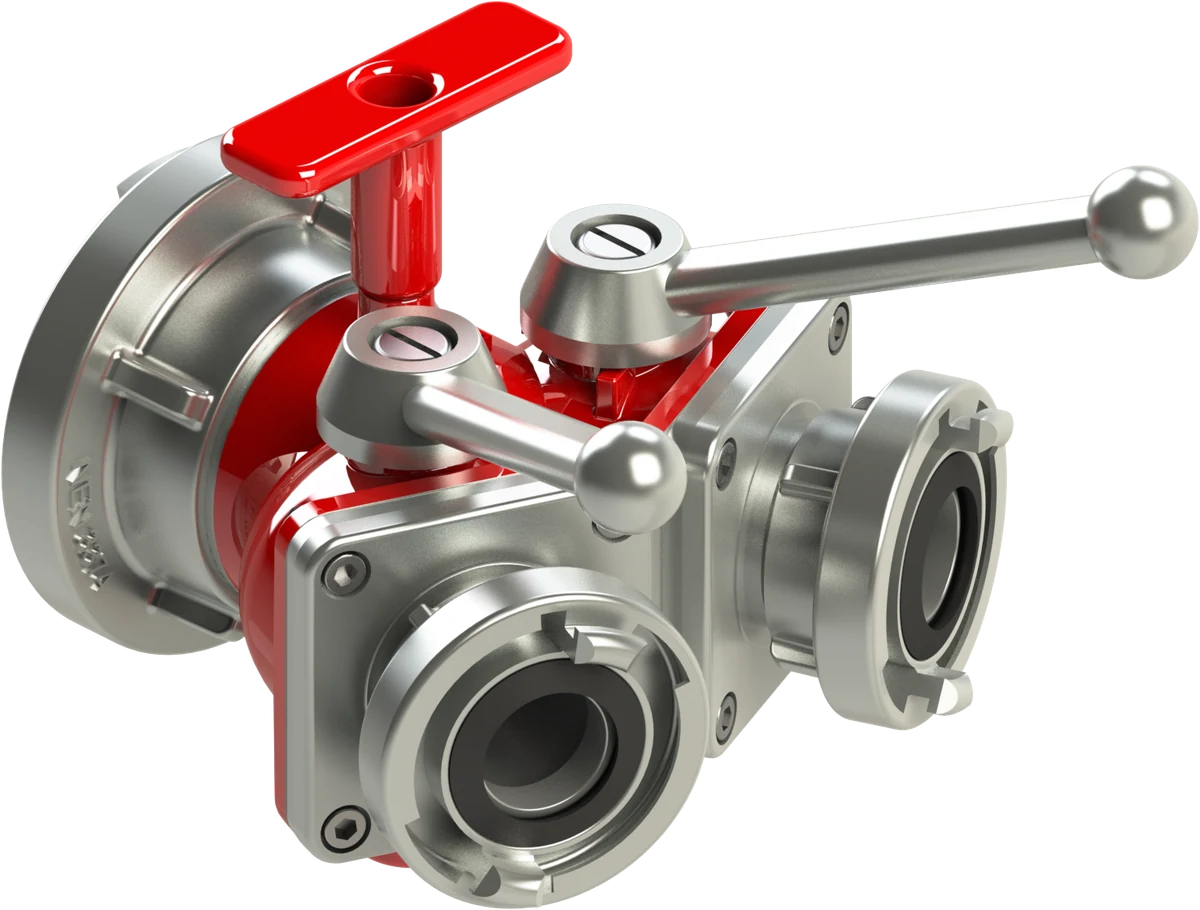
- Feed the curtain from its own outlet on a dividing piece. You can then lay the line dry, set the device down, walk back and open the valve from a cooler spot.
Where the curtain cannot wet the surface, cool the surface directly. The report names a water cannon (a monitor) aimed at the exposed building as another technique in use, though it did not test one. In our range of monitors, the MONTMIRAIL oscillates horizontally over 55° and the POKET takes an optional oscillating adapter for unmanned cooling. The article on portable and fixed monitors compares them.
What a water curtain does not do
A water curtain acts on one route of fire spread: radiant heat. The Dutch study left the other routes aside: hot gases, flame contact and flying brands. It was also a laboratory test. There was no wind in the hangar, and the authors note that wind can blow a curtain apart. They add that a real facade is irregular and has windows, broken or not, so an even film of water is not certain.
The water itself is the other limit. At 800 to 1800 l/min for the large types, a curtain draws on the same hydrant or pump as the attack lines. That is a reason to choose the smallest type that covers the object. The test points the same way: the 13 l/min on the sheet brought the rise from about 130 °C to about 25 °C, with far less water than the roughly 200 l/min in the air. Whether wetting alone would have been enough was not tested, and the report asks for more research on that point.
Gas and vapour clouds: a limited effect
Against a gas or vapour cloud a water curtain dilutes and deflects, and the cloud remains. That is the outcome of the NIPV literature study Waterschermen en waterstralen of 22 December 2023. A few metres behind the curtain, trials with ammonia showed reductions in concentration of up to 90 %. Further away the reduction fell off sharply, and it also dropped at higher wind speeds.
Most of the effect seems to be mechanical: the curtain pushes the cloud up and sideways and mixes air into it. In French trials in the winter of 1998 to 1999 that the study describes, concentrations at the edges of the curtain were higher than without it. On average about 15 % of the ammonia dissolved in the water, although ammonia dissolves readily. For chlorine, which dissolves poorly, the study found only a limited reduction. Its summary: fully mitigating a vapour cloud does not seem realistic.
This matters on Seveso sites. Annex II of the Seveso III Directive 2012/18/EU, on the content of the safety report, names "water spray" and "vapour screens" as examples of equipment that limits the consequences of a major accident. If a mobile water curtain is the line of defence in one of your scenarios, check that scenario against the NIPV study.
Before you order
Three details decide which type fits:
- the coupling system and the size of the line that will feed it, in Belgium normally DSP 45 or 70
- the flow and pressure your pump or hydrant network can spare for it
- what it has to shield, and how wide and how high that object is
Send us these details and we will name a type with its flow and curtain size.
Frequently asked questions
Does a water curtain stop radiant heat?
Partly. In the 2015 test by the Dutch fire academy a vertical water curtain stopped a little more than half of the radiation, about 55 %. The wall behind it still heated up by about 130 °C. When the wall was kept wet as well, the rise was about 25 °C.
How much water does a water curtain use?
Our aluminium water curtains flow 300 to 1800 l/min depending on the type. As a rule of thumb, a type C curtain takes about 800 l/min at 5 bar and a type B about 1400 l/min. One large curtain can use the 1000 l/min that the Belgian circular of 14 October 1975 takes as sufficient for firefighting in most cases.
What pressure does a water curtain need?
5 to 8 bar at the inlet, according to the training handout of the Luxembourg CGDIS. Add the loss in the hose, as a rule of thumb about 2.2 bar per 100 m of 70 mm hose at 1000 l/min. At 2 bar the curtain in the Dutch test was only about 3.4 m high.
Does a water curtain work against a gas cloud?
Only to a degree. The NIPV literature study of December 2023 reports reductions of up to 90 % in ammonia concentration a few metres behind the curtain. The reduction falls sharply further away and at higher wind speeds. The cloud is mostly diluted and pushed aside, and the study calls full mitigation of a vapour cloud not realistic.