Camlock coupling types A to F: materials and limits
Camlock types A to F, DC and DP explained: which halves connect, which material suits which liquid, and the 10 and 16 bar limits of EN 14420-7.
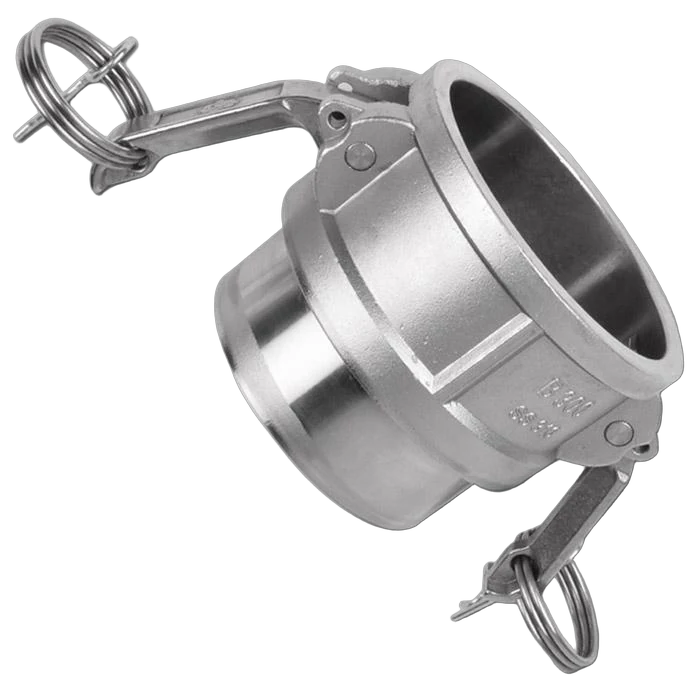
A camlock connection always has two different halves: a male adaptor (types A, E and F) and a female coupler with two cam arms (types B, C and D). The letter only says what sits on the other end, a thread or a hose tail, so any adaptor fits any coupler of the same size. For a hose you normally need a type C and a type E, in aluminium for water and in 316 stainless steel for corrosive liquids. EN 14420-7 limits cast aluminium camlocks and every DN 100 coupling to 10 bar and the other versions to 16 bar. A camlock is not a coupling for firefighting lines.
The eight types at a glance
Six letters describe the couplings themselves, and DC and DP are the cap and the plug. The adaptor is the male half: a plain spigot with a groove around it. The coupler is the female half: it holds the seal and the two cam arms. You slide the adaptor into the coupler and press both arms down by hand. The cams grip the groove and pull the adaptor onto the seal. To uncouple, you lift the arms. No spanner is needed.
| Type | Half | Other end | Connects to |
|---|---|---|---|
| A | Adaptor (male) | Female thread | Any coupler: B, C, D or DC |
| B | Coupler (female, with cam arms) | Male thread | Any adaptor: A, E, F or DP |
| C | Coupler | Hose tail | A, E, F or DP |
| D | Coupler | Female thread | A, E, F or DP |
| E | Adaptor | Hose tail | B, C, D or DC |
| F | Adaptor | Male thread | B, C, D or DC |
| DC | Dust cap, shaped like a coupler with cam arms | Closed | Closes an adaptor |
| DP | Dust plug, shaped like an adaptor | Closed | Closes a coupler |
Two adaptors do not connect to each other, and neither do two couplers. Both halves must also have the same nominal size. For a change of size there are reducing versions. Our camlock range includes hose couplings, threaded couplings, reducers and blind caps.
Which type on the hose and which on the tank
A hose gets the types with a hose tail, a fixed connection point gets the threaded types. With a type C on one end and a type E on the other, hoses can be joined end to end.
We would put the adaptor (type A or F) on the fixed side and the coupler on the hose. An adaptor has no moving parts and no seal. The half that stays outdoors on the tank is then the one that needs the least care, and a DC cap keeps it clean between transfers. The coupler, with its arms and its seal, goes back to the store with the hose, where it can be checked.
Camlocks are used where liquids are transferred at low pressure and lines are connected and disconnected often: on tankers, at tank terminals, in agriculture. For road tankers and tank containers we also carry dedicated tank couplings.
The letter alone is not an order: the nominal size and the thread belong with it. The manufacturer Dixon lists sizes from 15 mm (1/2 inch) to 200 mm (8 inch) and supplies the threaded types with either BSP or NPT thread. Those two threads do not screw together.
Two standards: EN 14420-7 and A-A-59326
In Europe camlocks are made to EN 14420-7:2022, "Hose fittings with clamp units, Part 7: Cam locking couplings". American-pattern camlocks follow the commercial item description A-A-59326, which replaced the military specification MIL-C-27487. Dixon's camlock brochure states that its couplers and adaptors interchange with all products made to A-A-59326D.
That interchangeability has limits. Dixon adds that no standard exists for the 15 mm and 200 mm sizes and that these generally do not interchange between manufacturers. As a rule, the EN version differs from the American one in the thread seal, which is flat, and in the hose tail, which has a smooth shank for safety clamps. When you add halves to an existing installation, tell your supplier which brand or standard the existing ones follow, or send a photo of the marking.
Aluminium, stainless steel, brass or polypropylene
The body material and the seal are both chosen against the liquid. Dixon makes camlocks in aluminium, stainless steel CF8M (equivalent to 316), bronze, brass, glass-filled polypropylene, glass-filled nylon and Hastelloy.
Aluminium is light and economical. For water and other liquids that do not attack it, we recommend it, because a large coupler has to be lifted by hand. 316 stainless steel is for liquids that corrode aluminium or brass and for products that must stay clean, such as food. In our agriculture range, camlocks come in aluminium and brass.
Polypropylene does not corrode and weighs little, but it has the lowest pressure rating: Dixon rates a 100 mm polypropylene camlock at 50 psi, which is about 3.4 bar. Dixon also warns that polypropylene halves should not be mixed with aluminium ones.
Then there is the seal. Dixon fits nitrile rubber (NBR) as standard in its metal camlocks and lists EPDM, FKM and PTFE-enveloped gaskets as alternatives. A stainless steel body is of little use if the seal inside it does not resist the liquid, so check both against the manufacturer's resistance list.
Pressure limits in the standard and at the manufacturer
The pressure limit of a camlock depends on material and size, and it falls as the size goes up. The scope of EN 14420-7 gives two ranges. All cast aluminium couplings and all couplings of size DN 100 work from a vacuum of 0.8 bar up to 10 bar. The other couplings go up to 16 bar. Both ranges apply at working temperatures from -20 °C to +65 °C.
Manufacturers publish their own ratings, in psi for the American pattern. The table shows what Dixon gives for metal camlocks (aluminium, brass, bronze, stainless steel) at 21 °C. Dixon states that these ratings are meant for liquids.
| Nominal size (mm) | Dixon rating (psi) | Converted (bar) |
|---|---|---|
| 15 | 150 | 10.3 |
| 20 to 50 | 250 | 17.2 |
| 65 | 150 | 10.3 |
| 75 | 125 | 8.6 |
| 100 | 100 | 6.9 |
| 125 to 150 | 75 | 5.2 |
| 200 | 50 | 3.4 |
Polypropylene and glass-filled nylon are rated lower: 125 psi (8.6 bar) in 15 and 20 mm, 100 psi (6.9 bar) from 32 to 50 mm, 60 psi (4.1 bar) in 75 mm and 50 psi (3.4 bar) in 100 mm.
The standard and the manufacturer's table do not give the same figure for every size. Go by the marking and the data sheet of the coupling you have in your hand. A hose assembly is rated by its weakest part: coupling, hose or clamp.
What a camlock is not made for
Compressed air and steam are the two uses to avoid. Dixon repeats the warning throughout its brochure: "Under no circumstances should camlock couplings be used in compressed air or steam applications." The standard is less strict on one point: the scope of EN 14420-7 covers liquids, solids and gases, "except liquid gas and steam". Where the standard and the manufacturer differ, we follow the manufacturer of the coupling, so no compressed air.
Dust caps and dust plugs are not pressure parts. Dixon states that types DC and DP "are not to be used in any pressure applications for safety and environmental reasons". They keep dirt out of an open half. A line under pressure is closed with a valve.
Release the pressure before you lift the arms. Dixon also sells vented safety camlocks that let static pressure escape on disconnection. They do not interchange with standard camlocks.
Why a camlock does not belong on a firefighting line
In Belgium a royal decree lays down the couplings for firefighting equipment, and the camlock is not among them. Article 1 of the Royal Decree of 30 January 1975 requires installations and equipment for firefighting to carry couplings of one of the types described in its annexes 1, 2 and 3. Those annexes describe the symmetrical DSP coupling in 45 and 70 mm, the AR coupling and the Guillemin coupling. A ministerial circular of 9 March 1982 points out that this duty applies to everyone who has firefighting equipment, industry and buildings included.
Pressure is the second reason. The decree lists the Guillemin coupling with a nominal pressure of 16 bar (PN 16), and delivery hose to DIN 14811 has a working pressure of 16 bar up to size 75 mm. Dixon rates a 75 mm metal camlock at 125 psi, about 8.6 bar, and EN 14420-7 stops at 10 bar for cast aluminium.
So keep the camlock for transfer work: filling and emptying tanks, moving liquids at low pressure. Whatever connects to a hydrant, a pump outlet or a nozzle gets DSP couplings or Guillemin couplings in Belgium, and Storz couplings where your neighbours across the border use them. Our comparison of Storz, DSP and Guillemin says which system is used where. The guide to coupling sizes and how to measure them helps you identify what you have.
What we need to know for your order
A camlock is specified by five things:
- the liquid and its temperature
- the working pressure, and whether the line also works under vacuum
- the nominal size and, for threaded types, BSP or NPT
- the type letter for each end
- the brand or standard of the halves you already have
Send us these details and we will propose the type, the body material and the seal.
Frequently asked questions
What is the difference between camlock type A and type B?
Type A is a male adaptor with a female thread; type B is a female coupler with cam arms and a male thread. They are opposite halves, so an A and a B of the same size connect to each other. The same goes for every adaptor (A, E, F) and every coupler (B, C, D).
Are camlocks from different brands interchangeable?
Within one standard, largely yes. Dixon states that its camlocks interchange with all products made to the American specification A-A-59326D. No standard exists for the 15 mm and 200 mm sizes. European camlocks to EN 14420-7 can differ in thread and hose tail, so check before you mix brands.
What pressure can a camlock coupling take?
It depends on material and size. EN 14420-7 gives 10 bar for cast aluminium camlocks and for all DN 100 couplings, and 16 bar for the others, between -20 °C and +65 °C. Manufacturers rate large sizes lower: Dixon gives 125 psi (8.6 bar) for a 75 mm metal camlock and 50 psi (3.4 bar) for a 200 mm one.
Can a camlock be fitted to a fire hose?
Not on firefighting equipment in Belgium. The Royal Decree of 30 January 1975 prescribes couplings of the DSP, AR or Guillemin type for firefighting installations and equipment. A camlock is for transferring liquids at low pressure.