Portable or fixed fire monitor: which one for which job
A monitor takes over above 1000 l/min or where no crew should stand. Portable or fixed, 750 to 5000 l/min, and what 3000 l/min asks of hoses and hydrants.
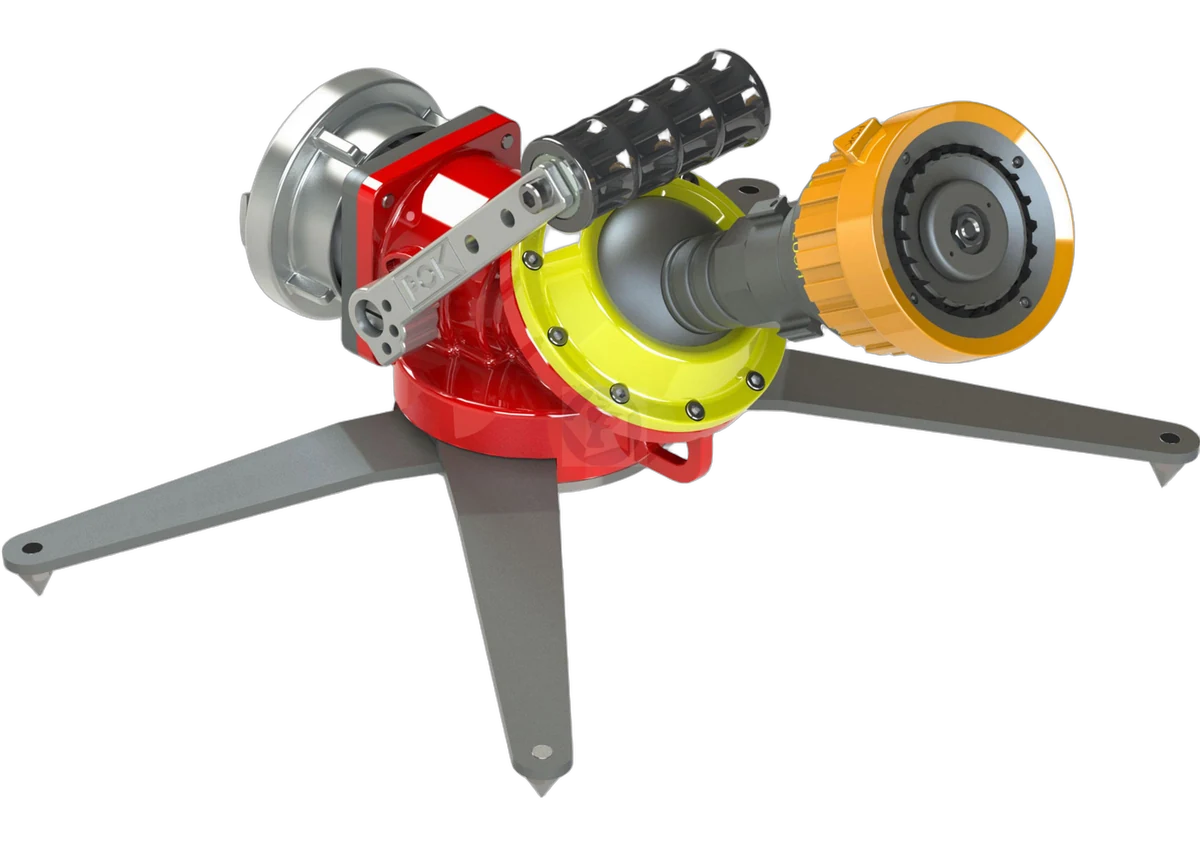
You need a monitor when the job takes more water than a crew can hold on a hand line, or when the stream has to keep running where nobody should stand. The standard for hand-held combination nozzles, EN 15182-2, covers flows up to 1000 l/min at 6 bar. The monitors in our range run from 750 to 5000 l/min. Choose a portable monitor when you cannot know in advance where the fire will be, and a fixed one where the risk never moves: a tank, a loading bay, a depot. Check the water supply first. A monitor at 3000 l/min takes three times the 1000 l/min on which the public firefighting water supply in Belgium is planned.
What a monitor does that a hand line cannot
A monitor is a large nozzle on its own base: the legs, the vehicle or the flange carry the reaction force of the stream. A crew on a 45 mm attack line works with 400 to 500 l/min, writes fire officer Karel Lambert of CFBT-BE. The scope of EN 15182-1 warns that reaction forces must be taken into account before a hand-held nozzle is chosen. With a monitor that force goes into the base, and the flow can rise to several thousand litres per minute.
The second reason is distance. A monitor can be aimed, locked and left running, so it cools a tank shell or a neighbouring facade while the crew stays out of the heat. Ground monitor and water cannon are other names for the same device. In Dutch it is a blusmonitor or waterkanon, in French a canon incendie or lance-canon.
Not every fixed stream needs a monitor. The MAMBA nozzle support is a ground base for a hand nozzle of up to 750 l/min, with a lockable vertical range from +30° to +70° and a pressure gauge. If you already own a suitable nozzle and the stream has to hold its position only now and then, the support is enough. For the nozzle itself, see our guide on how to choose a fire nozzle.
The monitors in our range
Our range has five POK monitors, from 750 to 5000 l/min. The flows of FROGGY, LMP 80 and PRIMATOR are stated at 7 bar at the monitor.
| Monitor | Flow (l/min) | Pressure (bar) | Horizontal range (°) | Vertical range (°) | Mounting |
|---|---|---|---|---|---|
| FROGGY Standard | 750 | 7 | -26 to +26 | +24 to +76 | Portable, foldable legs with carbide spikes |
| FROGGY Tactical | 1000 | 7 | -30 to +30 | +25 to +85 | Portable, foldable legs with carbide spikes |
| POKET | on request | on request | 360 | on request | Portable, titanium frame; also on a vehicle or a stationary flange |
| MONTMIRAIL | 1000, 2000 or 3000 | 16 (working pressure) | 55, oscillating | 25 to 85 | Portable, foldable legs with anchorage |
| LMP 80 | 5000 | 7; maximum working pressure 12 | -153 to +101 | 0 to +85 | Portable or fixed |
| PRIMATOR | 3000 | 7; PN 16 | 360 | -70 to +90 | Fixed, DN 80, on a hydrant or a platform |
MONTMIRAIL has a working pressure of 16 bar and a test pressure of 25.5 bar, but the product data does not say at which inlet pressure its three flow settings apply. For POKET the data on our site names no flow. Ask us for the data sheet of the version you have in mind.
The product data names POKET as usable with water and foam. For the other models, ask us about nozzle and foam options. Proportioning is the harder part. An inline inductor is built for one flow, and the inline inductors in our range come in 200, 400 and 800 l/min. A monitor at 2000 or 3000 l/min therefore gets its foam solution from the proportioning system of a vehicle or a fixed installation.
Portable: when the fire decides the position
A portable monitor is the right choice for a fire zone and for a company fire team that covers a whole site, because nobody knows beforehand where it will stand. FROGGY is the compact one: 750 l/min as Standard or 1000 l/min as Tactical, on foldable legs with carbide spikes. POKET is built for rapid deployment, with a titanium underframe, 360° horizontal adjustment and a safety shut-off that closes the monitor when it loses contact with the ground. MONTMIRAIL is the large one. You set its flow to 1000, 2000 or 3000 l/min, the throw is 70 m according to the product data, and a safety system works against flipping, lifting and sliding.
The limit of every portable monitor is the set-up. It has to be carried in, connected and anchored, and at 3000 l/min it needs three 70 mm supply lines or one 110 mm line. Count that time and those hoses in when you compare it with a fixed monitor.
Fixed: when the risk stays in one place
A fixed monitor suits a risk you can point at on the site plan: tank farms, loading bays and depots are the typical places. It stays connected to the firefighting water network, so no hose has to be laid. PRIMATOR is built for this: a DN 80, PN 16 monitor for a hydrant or a platform, with 3000 l/min at 7 bar, 360° rotation and a lockable handle. LMP 80 delivers 5000 l/min at 7 bar and can be set up as a portable or a fixed monitor.
A fixed monitor covers only what lies within its throw and its arc, and it cannot follow a fire that starts behind a wall. Our product data gives a throw for MONTMIRAIL only. So ask for the throw at the pressure your network delivers before you settle the location. On an industrial site we would put a fixed monitor on each risk you can name in advance and keep one portable monitor for everything else.
Oscillating monitors for unmanned cooling
An oscillating monitor swings the stream from side to side by itself and cools a surface without an operator. MONTMIRAIL oscillates horizontally over 55°. POKET takes an optional oscillating adapter, which the product data describes as meant for unmanned cooling.
At 3000 l/min an oscillating monitor takes 180 m³ per hour. Set the flow to what the water supply can sustain for the whole operation, not to the maximum of the monitor. If you want a screen between the fire and the object rather than water on the object itself, a water curtain is the other unmanned device. Our aluminium water curtains use 300 to 1800 l/min depending on the type, and our article on water curtains explains what they shield and what they do not.
What 3000 l/min asks of the hoses
One 70 mm hose cannot feed a monitor at 3000 l/min. Friction loss grows with the square of the flow: three times the flow means nine times the loss. French fire service training tables use the same 45, 70 and 110 mm diameters as Belgium. They give 2.2 bar per 100 m for a 70 mm hose at 1000 l/min and 1.12 bar per 100 m for a 110 mm hose at 2000 l/min. At 3000 l/min a single 70 mm hose would lose about 20 bar per 100 m, so the flow has to be split or the diameter has to go up. The table assumes 100 m of hose on level ground and 7 bar at the monitor, the pressure at which the product data states most flows.
| Supply over 100 m | Flow per line (l/min) | Friction loss (bar) | Pump pressure for 7 bar at the monitor (bar) |
|---|---|---|---|
| One 70 mm line | 3000 | about 20 | not workable |
| Two 70 mm lines | 1500 | 5.0 | 12.0 |
| Three 70 mm lines | 1000 | 2.2 | 9.2 |
| One 110 mm line | 3000 | 2.5 | 9.5 |
These are rules of thumb from training tables, not measured values of our hoses, and the real loss depends on the make and the lining. Add 1 bar for every 10 m the monitor stands above the pump. The full tables, also for Storz sizes, are in our article on pressure loss in 45 and 70 mm hoses.
We recommend three 70 mm lines or one 110 mm line. Two 70 mm lines work on paper over 100 m, but 12 bar at the pump leaves no margin for a longer line or a slope. The lines have to come together at the inlet of the monitor, through a collecting piece if there is only one inlet. So tell us which couplings your hoses have.
What it asks of the pump and the hydrants
A flow of 3000 l/min is 180 m³ per hour, and both the pump and the source have to keep that up. The federal technical sheet for the semi-heavy pumper (TF06, November 2006, in Dutch) lists a low-pressure pump of 2000 l/min nominal at 10 bar. On flow alone, one such pump covers the 2000 l/min setting of a MONTMIRAIL. For 3000 l/min, check the pump curve of your own vehicle or plan a second pump.
The public firefighting water supply in Belgium is planned on 1000 l/min. The ministerial circular of 14 October 1975 (in Dutch) states the principle: 120 m³ of water, delivered evenly over two hours at a flow of 1000 l/min, is enough in most cases. A monitor at 3000 l/min uses those 120 m³ in 40 minutes. The circular adds that higher flows can be required for particular establishments. It also says that a network that is not meshed, or that has mains under 100 mm inside diameter, may not reach the planned flows. Open water then has to supplement it.
For a first estimate of what a hydrant gives, Luxembourg's fire and rescue corps CGDIS teaches a rule of thumb in its training handout on water supply (in German). The yield in l/min is 15 times the diameter of the main in mm for an above-ground hydrant and 10 times for an underground one: about 1500 and 1000 l/min on a 100 mm main. For a fixed monitor, ask the water company or the site owner what flow and pressure the network delivers at that point.
What decides the model
Four answers settle most of the choice: the flow your water supply can sustain and for how long, where the monitor will stand (ground, vehicle, flange, hydrant or platform), the coupling system and size of your supply lines, and whether it is for water only or for water and foam. Send us these four points for a proposal from our monitors with the matching couplings.
Frequently asked questions
What is a fire monitor?
A fire monitor is a large nozzle on a fixed or portable base that delivers more water than a crew can hold on a hand line. Hand-held nozzles under EN 15182-2 go up to 1000 l/min at 6 bar; the monitors in our range go from 750 to 5000 l/min. A monitor can be aimed, locked and left running, with or without an operator.
What flow does a portable monitor need?
As much as the setting it runs on: in our range 750 or 1000 l/min for FROGGY and 1000, 2000 or 3000 l/min for MONTMIRAIL. At 3000 l/min the supply takes three 70 mm lines or one 110 mm line, and the source has to deliver 180 m³ per hour.
How far does a monitor throw?
The product data for MONTMIRAIL states a throw of 70 m. Throw depends on the flow and on the pressure at the monitor, so a figure is only valid for the pressure it is stated at. For a fixed monitor, ask for the throw at the pressure of your own network before you choose the position.
Can a monitor throw foam?
According to the product data, POKET is usable with water and foam; for the other models, ask us about nozzle and foam options. The monitor needs ready foam solution at its full flow. The inline inductors in our range go up to 800 l/min, so larger monitors get their foam solution from the proportioning system of a vehicle or a fixed installation.