How to choose a fire nozzle: flow, type and pressure
Choose a fire nozzle by flow at 6 bar, flow control, pressure system and coupling. For interior attack in Belgium: 45 mm, EN 15182-2, 500 l/min, DSP 45.
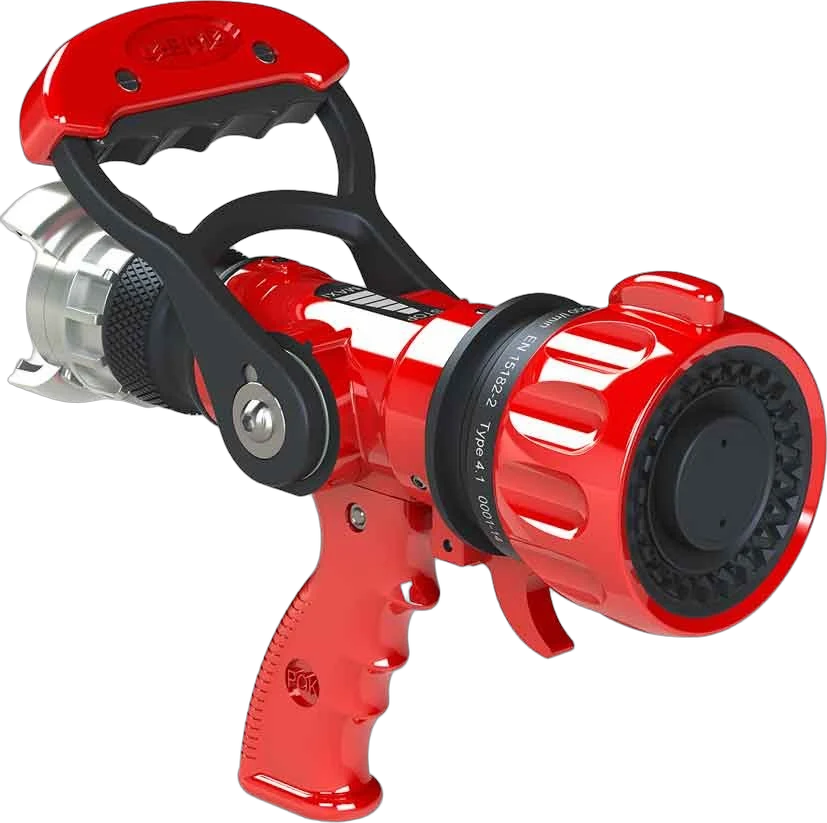
Choose a fire nozzle on four points: the flow it delivers at 6 bar, how that flow is controlled (by a ring or automatically), the pressure system it runs on and the coupling. For interior attack the Belgian benchmark is a 45 mm combination nozzle with a nominal flow of 500 l/min at 6 bar, the kind of nozzle that EN 15182-2 covers. It has a pattern from full jet to wide cone, a flush position and a DSP 45 coupling on a swivel. A high-pressure nozzle on the reel, with 150 to 180 l/min, is quicker at a car or bin fire but has no reserve when a room fire grows.
Flow comes first, and it is quoted at 6 bar
The flow of a nozzle decides how much heat a line can take out of a fire. The figure only means something with a pressure next to it. EN 15182 states its flow limits at a reference pressure of 6 bar. Luxembourg's fire and rescue corps CGDIS reckons on 5 to 6 bar at a combination nozzle in its water supply handout (in German).
For a 45 mm attack line the usual figure is 400 to 500 l/min. The Belgian federal technical sheet FT14 (May 2017, in French) was drawn up for a federal contract on behalf of the fire zones. That contract ran until 17 April 2018, but its list is still a sound starting point for a specification. It asks for a nominal flow of 500 l/min at 6 bar, automatic regulation of the water pressure, a pistol grip and a bale-handle shut-off. The head has fixed spray teeth and turns from straight jet to diffused jet. The inlet is a DSP 45 mm half coupling on a swivel joint.
The hose has to carry what the nozzle asks. French fire service training tables put the loss in 45 mm hose at 1.5 bar per 100 m at 250 l/min and at 6 bar per 100 m at 500 l/min. Twice the flow gives four times the loss. These are rules of thumb, not measured values for a particular hose. For a complete line worked out step by step, see pressure loss in 45 and 70 mm hose.
Low pressure on 45 mm or high pressure on the reel
A 45 mm low-pressure line delivers at least twice the water of a high-pressure reel. Fire officer Karel Lambert of CFBT-BE describes the usual Belgian reel as 80 m of hose with an inside diameter of 25 mm. With the right pump settings it gives about 180 l/min. That is 3 litres per second, a theoretical cooling capacity of 9 MW. In practice it is lower, Lambert writes. A 45 mm nozzle delivers between 400 and 500 l/min, and Lambert puts the cooling capacity of a low-pressure line at 15 to 20 MW.
The reel has real advantages: it comes off the drum in a straight line, one firefighter can handle it in a room and it is rolled back up afterwards. For a car or bin fire it is the faster choice. Lambert's objection is about interior attack. Most room fires can be put out with the reel, but nobody knows in advance which ones cannot. The flow of a reel cannot be doubled when a window fails and the fire takes off. He compares it to driving at 120 km/h on the motorway without a seat belt.
Our advice: take a 45 mm low-pressure nozzle into a building and keep the high-pressure nozzle for small fires outdoors.
Selectable flow or automatic
On a selectable-flow nozzle a ring fixes the flow. An automatic nozzle regulates its own pressure, and the operator meters the water with the handle.
With a flow ring, French training material teaches a fixed order: set the ring, set the pattern, open the handle. The flow is then a known figure. That counts on a foam line, where an inline inductor is built for one flow and the nozzle behind it has to match. The inline inductors in our range come in 200, 400 and 800 l/min.
In an automatic nozzle it is typically a spring mechanism that keeps the pressure within its working range while the flow changes. The same French course notes that the single handle makes pulsing easier and reduces water hammer.
For a crew that does interior attack we recommend the automatic nozzle: the operator has one handle to think about in smoke. The federal sheet FT14 made the same choice. On a foam line, take the flow ring.
Turbokador, Legende and I-POK side by side
The three POK nozzles below stand for the three cases: adjustable flow, automatic and high pressure.
| Nozzle | System | Flow (l/min) | Flow control |
|---|---|---|---|
| Turbokador | Low pressure | 150 to 1000, depending on the version | Adjustable flow, rotating turbine ring |
| Legende 500 | Low pressure, works from 2 bar | 500 | Automatic pressure and flow regulation |
| I-POK | High pressure, 40 bar | 150 | Adjustable, depending on the type |
All three give a full jet, an attack jet and a water curtain, and have a swivel inlet that takes different coupling types. Turbokador and Legende are certified to EN 15182-2 and have a flush position.
Each has its limits. I-POK is a high-pressure nozzle: 150 l/min is a flow for gas cooling and small fires, not for a room that is fully alight. Turbokador has a rotating turbine ring, while FT14 specifies fixed spray teeth. Tell us if your specification follows the federal sheet on that point. With the higher flow versions, mind the reaction force: a note in EN 15182-1 tells buyers to take it into account before they choose a nozzle. For flows a crew can no longer hold by hand, read our article on portable and fixed monitors. The other lines (Criquet, Aquastar and the 3-position nozzles) are on the nozzle page.
What EN 15182 covers
EN 15182 is the European standard for hand-held branchpipes for fire service use. Part 1 (2019) holds the common requirements, the test methods and the marking. Parts 2 to 4 each describe one family.
| Part | Kind of nozzle | Nominal pressure | Maximum flow at 6 bar (l/min) |
|---|---|---|---|
| EN 15182-2 | Combination nozzles (full jet and adjustable spray) | PN 16 | 1000 |
| EN 15182-3 | Smooth bore, or one fixed spray angle | PN 16 | 1000 |
| EN 15182-4 | High-pressure nozzles | PN 40 | 250 |
Part 3 carries a warning that matters to a buyer. These nozzles "offer no or inadequate protection for firefighters when the spray angle is less than 30°" and are not to be used "in high risk firefighting situations such as internal attack". A smooth bore throws far and does its work outdoors. For an attack crew it is the wrong nozzle.
A nozzle for gas cooling
Gas cooling needs a nozzle that gives 150 to 200 l/min in a cone of 40 to 60°, with a valve that opens and shuts in one movement. Those are Karel Lambert's settings for the short pulse, with the nozzle at 45° or more to the floor and one or two litres of water per pulse. For the long pulse the cone narrows to about 30° and the nozzle stays open for about two seconds. At 150 to 200 l/min, he writes, it makes no difference whether the nozzle is a high-pressure or a low-pressure one.
Gas cooling makes the way to the seat of the fire safer. Putting the fire out takes a direct attack with more water, so a nozzle for interior attack needs both: a low flow for pulsing and the full 400 to 500 l/min for the attack. According to its product data, Legende is suitable for smoke gas cooling and pulsing. Try any nozzle with gloves on, because the operator has to find the cone setting by feel.
Coupling, flush position and what to send us
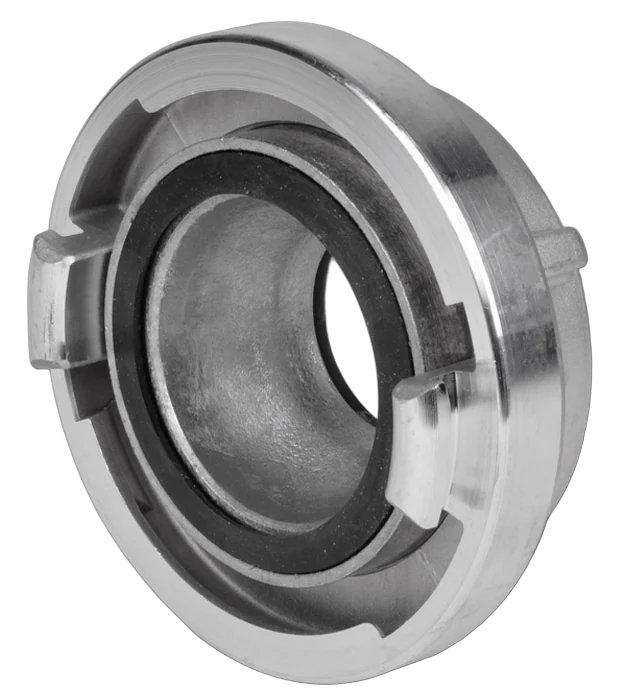
In Belgium a 45 mm nozzle carries a DSP 45 coupling. The Royal Decree of 30 January 1975 (Dutch text) lays down the type couplings for firefighting equipment. The self-sealing symmetrical delivery coupling of 45 and 70 mm in its annex 1 is the one sold as DSP. Dutch, German and Luxembourg brigades work with Storz. Our three nozzles have a swivel inlet for different coupling types, so state which one you need when you order.
In the flush position, dirt that keeps the nozzle from working is washed out. FT14 also asks for a filter against coarse particles that the flush position cannot remove.
To name the model and the version we need four points, which you can send through our contact page:
- hose diameter and coupling, for example DSP 45 or Storz C
- low or high pressure, and the pressure your pump can deliver at the nozzle
- the flow you want, set by a ring or automatic
- for foam: the flow of your inline inductor
Frequently asked questions
What flow should a nozzle for interior attack have?
A 45 mm attack nozzle delivers between 400 and 500 l/min, and the Belgian federal sheet FT14 sets the nominal flow at 500 l/min at 6 bar. Gas cooling on the way in is done at 150 to 200 l/min, so the nozzle needs a low setting as well.
What is the difference between a selectable-flow and an automatic nozzle?
On a selectable-flow nozzle a ring fixes the flow before the nozzle is opened. An automatic nozzle regulates its own pressure and the operator meters the water with the handle. In our range Legende is automatic at 500 l/min, while Turbokador has an adjustable flow from 150 to 1000 l/min depending on the version.
Is a high-pressure nozzle enough for a room fire?
For most room fires it is, but there is no reserve. A Belgian high-pressure reel delivers about 180 l/min, a 45 mm low-pressure line 400 to 500 l/min. The flow of a reel cannot be doubled when the fire grows, which is why we advise a 45 mm low-pressure nozzle for interior attack.
Which coupling does a fire nozzle need in Belgium?
A DSP 45 coupling on a 45 mm line. The Royal Decree of 30 January 1975 lays down the type couplings for firefighting equipment in Belgium, and Storz is not one of them. Our nozzles have a swivel inlet for different coupling types, so brigades in the Netherlands, Luxembourg or Germany can ask for a Storz coupling.