Firefighting foam types: which concentrate for which fire
Fluorine-free AR foam at 3 % covers hydrocarbons and polar solvents, class A foam works at 0.1 to 1 %. Foam types, expansion ratios and how much to stock.
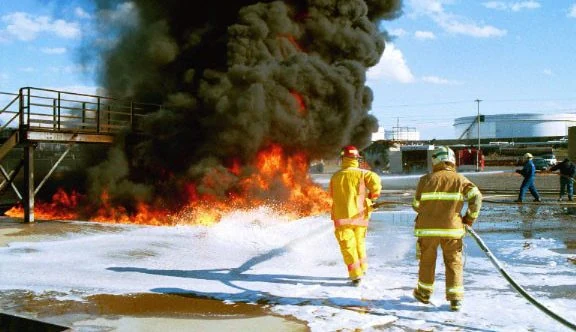
Four kinds of foam concentrate cover almost every job: fluorine-free foam for hydrocarbon fires, alcohol-resistant (AR) foam for water-miscible liquids such as alcohols and acetone, class A foam for solid materials, and training foam. Concentrates for liquid fires are typically mixed at 3 % or 6 %, class A concentrates at 0.1 to 1 %. AFFF, the film-forming foam with fluorosurfactants, is being phased out in the EU under Regulation (EU) 2025/1988.
The foam types side by side
The fuel decides the concentrate, and the concentrate decides the proportioning rate. That rate is the share of concentrate in the foam solution: at 3 %, 100 litres of solution hold 3 litres of concentrate and 97 litres of water.
| Foam type | Made for | Typical proportioning rate (%) | In our range |
|---|---|---|---|
| Fluorine-free, alcohol-resistant (F3 AR) | Hydrocarbons and water-miscible liquids (class B), solid materials (class A) | 3 on class B, from 0.3 on class A | ECOPOL |
| Class A foam | Solid materials: wood, paper, vegetation, vehicles | 0.1 to 1 | BIO FOR N |
| Training foam | Exercises and calibration of foam systems, never real fires | 3 or 6 | BIO T |
| AFFF and AR-AFFF (with fluorosurfactants) | Hydrocarbons; AR versions also water-miscible liquids | See the data sheet | Not recommended, see below |
The rates in the first three rows are the ones the manufacturer, BIOEX, states for ECOPOL, for class A agents in general and for BIO T. Another make, or another version of the same product, can have a different rate, so read the label on the drum before you set the inductor. Fluorine-free concentrates without alcohol resistance exist as well. They are made for hydrocarbons only.
Hydrocarbons or polar solvents: when foam must be alcohol-resistant
Class B fires fall into two groups, and what separates them is whether the liquid mixes with water. Petrol, diesel and other hydrocarbons do not. Alcohols, acetone and other polar solvents do, and they break down a foam that is not alcohol-resistant. An AR concentrate contains a polymer that forms a protective layer between the burning liquid and the foam.
EN 1568-4, the European test standard for foam on water-miscible liquids, uses two fuels only: acetone and isopropanol. Its scope warns that on other such liquids the performance of foams "can differ considerably", and it names methyl ethyl ketone (MEK) as an example. If you store another solvent, ask the foam manufacturer for test results on that liquid before you rely on the rate on the label.
Where both groups can occur, we recommend one alcohol-resistant concentrate for everything rather than two separate products. The crew then has one product on the vehicle and one setting on the inductor, and the wrong drum cannot end up at the wrong fire. ECOPOL fits that approach: the BIOEX product page for ECOPOL gives 3 % on hydrocarbon and polar solvent fires and from 0.3 % on class A fires. Check which version you have, because ECOPOL 3x6 takes 6 % on polar solvents.
AFFF: the film-forming foam on its way out
AFFF stands for aqueous film forming foam, and the film comes from fluorosurfactants. A thin layer of water spreads between the fuel and the foam, cools the liquid and keeps the vapours in. Those fluorosurfactants are PFAS, and Regulation (EU) 2025/1988 ends their use in firefighting foam. From 23 October 2030, foam with 1 mg/L of PFAS or more may no longer be placed on the market or used. For public fire services and for training and testing, use ends on 23 April 2027, with the exceptions listed in paragraph 6 of the restriction. Seveso establishments have until 23 October 2035. Our article on the PFAS deadlines for firefighting foam sets out which date applies to whom.
Fluorine-free foams work with the foam blanket itself, without a film. BIOEX warns that changing to them "is not a 'drop-in' replacement for AFFFs". Check the proportioning rate, the foam nozzle and the inductor again when you switch.
Class A foam: one litre in a thousand
A class A concentrate lowers the surface tension of water. The water soaks into wood, bales or vegetation and does not run off, and the foam clings to the surface. The rates are low, from 0.1 to 1 %: at 0.1 %, 1000 litres of solution hold 1 litre of concentrate.
BIO FOR N is the class A concentrate in our range, fluorine-free and biodegradable, for wildfires, house fires and vehicle fires. It clings to vertical surfaces and can be applied as low, medium or high expansion foam. BIOEX states a rate from 0.1 % on class A fires and 0.5 % on hydrocarbon fires.
The product has two limits. BIOEX names it for minor hydrocarbon fires only and does not present it as alcohol-resistant. For a tank, a bund or any polar solvent, take a class B concentrate. The second limit is the dosing: our inline inductors are marked 0, 1, 2, 3, 4, 5 and 6 %, which is too coarse for 0.1 or 0.5 %. Below 1 % you need a proportioner built for those low rates.
Training foam stays on the training ground
Training foam has deliberately reduced extinguishing power. BIO T forms a light foam that lets the fuel re-ignite quickly, so a crew can repeat the exercise, and it settles fast. BIOEX formulates it for live fire training on class A and class B fires and for calibrating foam systems, at 3 % or 6 %. The manufacturer states that it is "NOT suitable for real firefighting application".
Keep training foam apart from operational stock and mark the drums, so that a training drum never ends up on a vehicle. Order what you will use within two years: BIOEX gives a warranty of 2 years on training concentrates, against 10 years on synthetic firefighting concentrates.
Low, medium and high expansion
The expansion ratio is the volume of finished foam divided by the volume of foam solution that produced it. A ratio below 20 is low expansion, from 20 to below 200 medium expansion, and 200 or more high expansion. In Belgium you will also hear heavy, medium and light foam, after the Dutch zwaar schuim, middelschuim and lichtschuim. French speakers say bas, moyen and haut foisonnement.
The foam nozzle or generator sets the expansion, far more than the concentrate does: ECOPOL, BIO FOR N and BIO T can each be used at all three levels. With 200 l/min of foam solution, a ratio of 10 gives 2 m³ of foam per minute and a ratio of 100 gives 20 m³.
As a rule of thumb, low expansion foam is dense and can be thrown over a distance with a foam nozzle or a monitor. It is the usual choice for hydrocarbon fires in tank storage and refineries. Medium expansion foam covers a spill or a solvent store quickly with little water, but is more sensitive to wind. High expansion foam fills volumes such as warehouses, cellars and engine rooms. According to BIOEX's overview of low, medium and high expansion, it is not suitable for outdoor use. Our self-aspirating foam nozzles produce low or medium expansion foam, or both, in 200, 400 and 800 l/min.
How much concentrate do you need?
Concentrate consumption is flow times rate times time: the flow of foam solution through the nozzle in l/min, the proportioning rate and the minutes you want to keep foaming. A 400 l/min foam nozzle at 3 % uses 400 × 0.03 = 12 litres of concentrate per minute, or 180 litres in fifteen minutes. At 6 % that doubles to 24 l/min and 360 litres.
| Flow of foam solution (l/min) | Concentrate at 3 % (l/min) | A 100 litre tank lasts (min) | A 150 litre tank lasts (min) |
|---|---|---|---|
| 200 | 6 | 16 | 25 |
| 400 | 12 | 8 | 12 |
| 800 | 24 | 4 | 6 |
The durations are rounded down to full minutes. Our mobile foam unit comes with a tank of 100 or 150 litres. Our inductors and foam nozzles come in 200, 400 and 800 l/min, and the two must have the same nominal flow. For the set-up, see how an inline inductor works.
How long you have to keep foaming follows from your emergency plan or from the design of the installation. Start from that duration and work back to litres.
What EN 1568 says about a concentrate
EN 1568 is the European standard for foam concentrates, in four parts. Parts 1, 2 and 3 cover medium, high and low expansion foam on water-immiscible liquids, part 4 low expansion foam on water-miscible liquids. One concentrate can meet several parts, so a data sheet lists them one by one. For polar solvents, part 4 should be among them.
Look at the edition and the exact product name as well. A 2026 edition of all four parts was ratified in March 2026 as the successor to EN 1568:2018, so older certificates quote 2018. Each part states that "any type approval according to this document is invalidated by any change in composition of the approved product". A certificate for one version of a concentrate says nothing about another version.
Storing concentrates and changing product
Do not mix two concentrates in one tank without data from the manufacturer. The BIOEX FAQ on foam concentrates repeats the NFPA recommendation: "different brands and types of foam concentrates should not be mixed for storage unless specific data is provided by the manufacturer". So do not top up a half-full tank with another product, and start every change of concentrate with an empty, cleaned tank. If the old product was a fluorinated foam, that cleaning comes with a legal limit: the fluorine-free foam that later comes out of the cleaned equipment may contain no more than 50 mg/L of PFAS.
Tell us through the contact page which liquids are stored on your site, what flow your foam nozzles have and what is in your tanks today. We will work out the concentrate and the number of litres with you. All concentrates and foam equipment are on our foam page.
Frequently asked questions
What is the difference between 3 % and 6 % foam concentrate?
The percentage is the share of concentrate in the foam solution. A 3 % concentrate needs 3 litres per 100 litres of solution, a 6 % concentrate needs 6 litres. At a flow of 400 l/min that is 12 or 24 litres of concentrate per minute. Set the inductor to the rate on the label of the drum.
When do I need alcohol-resistant foam?
As soon as the burning liquid mixes with water. Alcohols, acetone and other polar solvents break down a foam that is not alcohol-resistant. EN 1568-4 tests AR concentrates on acetone and isopropanol; for other solvents, ask the manufacturer for test results on that liquid.
What is the expansion ratio of foam?
The expansion ratio is the volume of finished foam divided by the volume of foam solution. Below 20 it is low expansion foam, from 20 to below 200 medium expansion and from 200 upwards high expansion. At a ratio of 10, 100 litres of solution become 1000 litres of foam.
Is AFFF still allowed in the EU?
For a limited time only. Regulation (EU) 2025/1988 bans the placing on the market and the use of firefighting foam with 1 mg/L of PFAS or more from 23 October 2030. For public fire services, training and testing, use ends on 23 April 2027, subject to the exceptions in the regulation. Seveso establishments have until 23 October 2035.