Fire hose coupling sizes: Storz, DSP, AR and Guillemin
Storz couplings go by lug spacing (31, 66, 81, 89 or 133 mm), Belgian DSP, AR and Guillemin couplings by hose diameter. Size tables and how to measure.
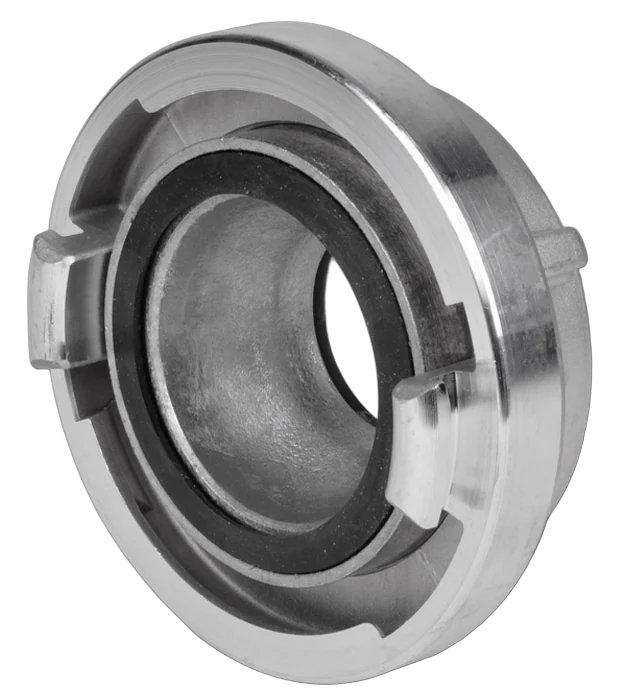
Fire hose couplings are sized in two different ways. A Storz coupling is identified by its lug spacing: 31 mm (D), 66 mm (C), 89 mm (B) or 133 mm (A), plus the 81 mm size of the Dutch fire service. The Belgian type couplings are named after the hose they fit: DSP in 45 and 70, AR in 110 and Guillemin in 45, 70, 90, 110 and 150, as laid down in the Royal Decree of 30 January 1975. So on a Storz you measure the distance between the lugs, and on a DSP, AR or Guillemin you measure the bore and the hose.
Storz sizes: the lug spacing decides
Two Storz halves connect when their lug spacing is the same, whatever hose is bound to them. The lug spacing is the distance between the inner faces of the two lugs that sit opposite each other on the coupling. These are the German sizes, which Luxembourg uses as well, and the Dutch one.
| Storz size | Lug spacing (mm) | Hose inside diameter (mm) |
|---|---|---|
| D | 31 | 25 |
| C 42 | 66 | 42 |
| C 52 | 66 | 52 |
| B | 89 | 75 |
| A | 133 | 110 |
| Dutch fire service | 81 | 52 and 75 |
C 42 and C 52 have the same coupling head, so a 42 mm hose connects straight to a 52 mm hose. Only the hose tail differs. The German delivery couplings are standardised in DIN 14301 (D), DIN 14332 (C 42), DIN 14302 (C 52) and DIN 14303 (B).
The Netherlands is the case to watch. Most Dutch brigades use a Storz coupling with 81 mm lug spacing on their 52 mm hoses and on their 75 mm hoses, so that every hose and every appliance connects to every other. Size tables usually list this coupling as Storz 65. It does not fit the German 89 mm B coupling without an adapter.
Storz is not one of the Belgian type couplings. It still turns up here: the DURATEX hose in our range comes with Storz couplings as standard, and the federal hose sheet discussed below has Storz as an option on 150 mm hose.
DSP, AR and Guillemin sizes in the Belgian decree
The Belgian type couplings are sized by nominal diameter, and that figure is the inside diameter of the hose. Article 1 of the Royal Decree of 30 January 1975 (page in Dutch) says that installations and equipment for firefighting must carry couplings that conform to one of the types in its annexes 1, 2 and 3. Annex 1 is the coupling sold as DSP, annex 2 the AR coupling and annex 3 the Guillemin coupling with nominal pressure PN 16. The figures below come from the dimension tables and drawings as published in the Belgian Official Gazette of 9 April 1975.
| Coupling | Nominal diameter | Bore of the hose tail (mm) | Hose inside diameter (mm) | Pipe thread on threaded halves |
|---|---|---|---|---|
| DSP | 45 | 39 | 45 | G 1 1/2 or G 2 |
| DSP | 70 | 64 | 70 | G 2 1/2 |
| AR | 110 | 100 | 110 | G 4 or G 4 1/2 |
| Guillemin | 45 | 40 | 45 | G 1 1/2 or G 2 |
| Guillemin | 70 | 65 | 70 | G 2 1/2 |
| Guillemin | 90 | 82 | 90 | G 3 |
| Guillemin | 110 | 100 | 110 | G 4 or G 4 1/2 |
| Guillemin | 150 | 140 | 150 | G 6 |
For the AR coupling the decree gives a drawing and refers to the Guillemin table for the thread. An AR coupling may also be made in nominal diameter 150, and it must then be interchangeable with the Guillemin coupling of that size. The Guillemin 150 exists only with a locking ring. For Guillemin, the decree gives the hose diameters as indicative values for delivery hoses.
Catalogues also list the DSP couplings as DSP 40 and DSP 65, or as 40/45 and 65/70, and the AR as 100/110. That is the French way of naming: the first figure is the bore, the second the hose. French fire service training documents speak of DSP couplings of 40 and 65 on hoses of 45 and 70 mm. It is one coupling under two names.
The thread column comes with a warning. The decree adds that the characteristics of the threads may differ at the user's request. The table tells you what to expect, and the part in your hand tells you what you have.
Which coupling goes on which hose in Belgium
On Belgian fire service hose, the diameter tells you the coupling. The federal technical sheet for delivery hoses of 2017 (in Dutch) lists 25 mm hose for forest fires with Guillemin couplings, 45 and 70 mm hose with DSP, 110 mm with AR and 150 mm with Guillemin. Storz appears there once, as an option on the 150 mm hose. The hoses on that sheet are marked at both ends with, among other things, the diameter and the working pressure, so look for that marking first.
Across the border the picture changes. France works with DSP and AR as well, Germany and Luxembourg with Storz, the Netherlands with Storz at 81 mm. The decree has its own answer to that: Article 2 obliges the fire services to hold enough adapters to use the different equipment and installations in their area. If only a few connections differ, say one pump outlet or the vehicle of a Dutch neighbour, a set of adapters is enough and no hose has to be re-coupled. The differences are set out in Storz, DSP and Guillemin by country.
How to measure a coupling
You need a calliper, and the half coupling has to be uncoupled. A ruler will do for the larger sizes.
- Take a photo of the face and of the side. A Storz half shows two lugs standing on its face. DSP, AR and Guillemin halves have a shell that hooks into the opposite half, usually with a locking ring behind it. French fire service training material describes the ring of the AR as wave-shaped.
- On a Storz, measure the lug spacing: across the centre, from the inner face of one lug to the inner face of the opposite lug. You should find 31, 66, 81, 89 or 133 mm.
- On a DSP, AR or Guillemin, measure the bore of the hose tail. A bore of 39 or 40 mm means size 45, 64 or 65 mm means size 70, and 100 mm means size 110. The bore gives the size, not the family: on a DSP 45 and a Guillemin 45 it is nearly the same (39 and 40 mm). That is why the photo comes first.
- Find the inside diameter of the hose. Read it from the marking, or measure the outside of the hose tail on a loose coupling. On a Storz C this is what separates 42 from 52. A flat hose cannot be measured straight across: its flat width is half the circumference, roughly 71 mm for a 45 mm hose and 110 mm for a 70 mm hose.
- On a threaded half, note male or female and measure the thread diameter in millimetres. G is a pipe thread, and its inch figure is a nominal pipe size that the calliper will not show you.
- Note whether the half has a locking ring. The decree describes DSP and Guillemin halves with and without one. Manufacturer data for DSP adds that one of the two halves must have a ring, or the connection will not hold.
What to send us when you are not sure
A coupling name is too little to order on. "Storz C" covers two hose sizes. A Storz coupling for 75 mm hose can have 81 or 89 mm lug spacing. DSP 40 and DSP 45 are the same part. We advise ordering on measurements, because names and parts do not match one to one. Send us:
- a photo of the face and one of the side of the coupling
- the lug spacing (Storz) or the bore (DSP, AR, Guillemin) in millimetres
- the inside diameter of the hose, or its marking
- for threaded halves: male or female, and the measured diameter
- with or without a locking ring
- the material, if it is not aluminium
On that last point, the decree describes the type couplings in anodised cast aluminium and leaves a copper or stainless alloy to agreement between user and maker.
We supply Storz couplings, DSP and AR couplings and Guillemin couplings as hose couplings, threaded couplings, reducers and blind caps. Coupling keys differ per system, so name the coupling type when you order one. Camlock couplings follow another logic, with letter types and inch sizes: see camlock types A to F. Send us your photos and measurements and we will tell you which coupling you have.
Frequently asked questions
What is the lug spacing of a Storz C coupling?
A Storz C coupling has a lug spacing of 66 mm. C 42 and C 52 share the same coupling head and connect to each other. The difference is the hose tail, made for a hose of 42 or 52 mm inside diameter.
Does a Dutch Storz coupling fit a German Storz B?
No. Most Dutch brigades use Storz with a lug spacing of 81 mm, and the German B coupling has 89 mm. The two connect only through an adapter, so measure the lug spacing before you order.
Is DSP 40 the same coupling as DSP 45?
Yes. The Belgian Royal Decree of 30 January 1975 names the coupling after the hose: nominal diameter 45, with a bore of 39 mm and a tolerance of 1 mm. French documents name it after the bore, 40. The same goes for DSP 65 and DSP 70.
Which thread does a threaded DSP coupling have?
The Belgian decree gives G 1 1/2 or G 2 for size 45 and G 2 1/2 for size 70. It also allows other thread characteristics at the user's request. Measure the thread on the part you have before you order its counterpart.
Which coupling belongs on a 110 mm hose in Belgium?
The AR coupling. Annex 2 of the Royal Decree of 30 January 1975 draws it with a bore of 100 mm for a hose of 110 mm, and the federal technical sheet for delivery hoses of 2017 lists 110 mm hose with AR couplings. Hose of 150 mm carries Guillemin couplings.