Inline foam inductor: how it works, why it draws no foam
An inline inductor draws foam concentrate by Venturi effect and uses about a third of its inlet pressure. Set-up in seven steps and checks when no foam comes.
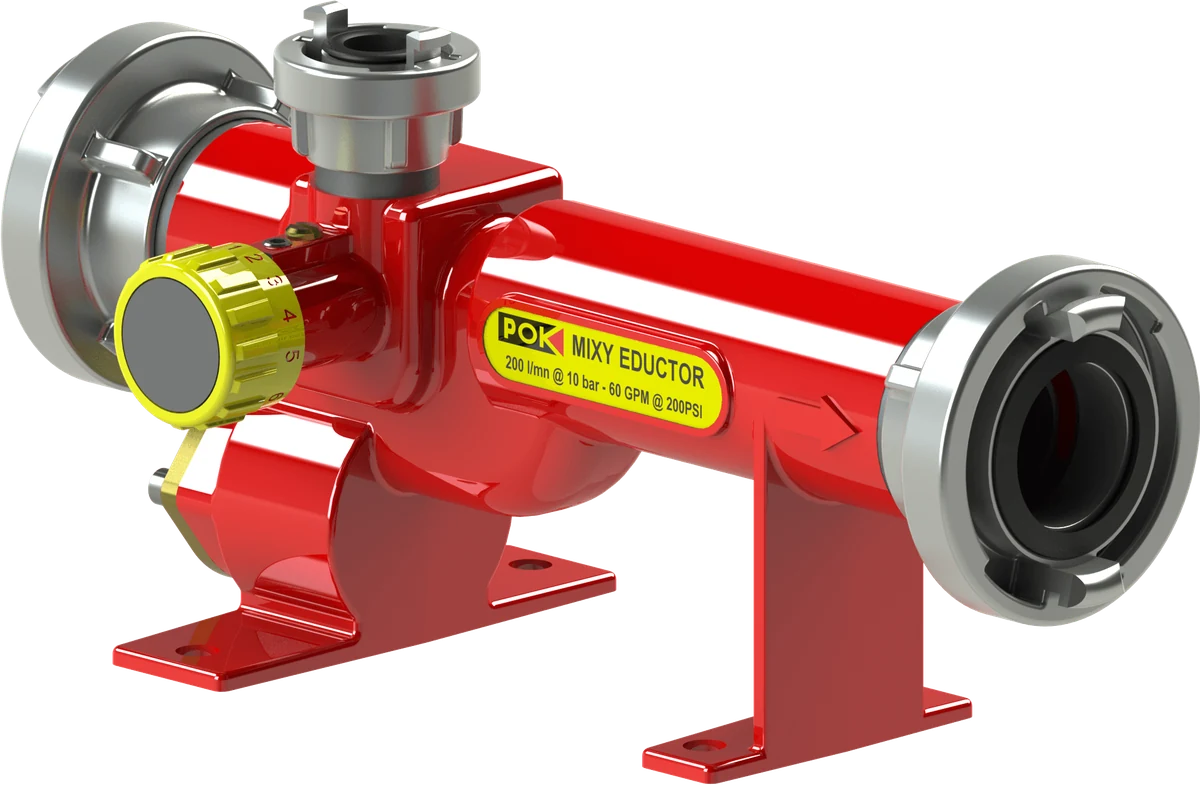
An inline inductor is a Venturi jet pump coupled into the hose line. The water is forced through a narrow orifice, the pressure behind it falls, and that draws foam concentrate up the pick-up hose at the rate set on the dial, from 0 to 6 %. It pays for this with pressure: an inductor uses up to about 35 % of its inlet pressure, and the rest has to cover the hose, the height and the foam nozzle behind it. When no foam comes, check the back pressure first (nozzle not fully open, wrong nozzle size, too much hose or height), then the inlet pressure, then the pick-up side.
How an inline inductor draws the concentrate
An inline inductor has no motor, and the water flow does the work. Inside the body the water is accelerated through an orifice into a suction chamber. The fast stream lowers the pressure there, and the concentrate rises through the pick-up tube and hose into the water. The foam solution only becomes foam at the foam nozzle, which adds the air.
The European standard EN 16712-1:2015 covers inductors PN 16 that "are used to proportion foam concentrate or other additives to the water stream and work using the Venturi principle". Belgian federal equipment sheets call the device a lijnmenger, Dutch suppliers a tussenmenger, French speakers a prémélangeur or injecteur-proportionneur, American texts an eductor.
Because the suction comes from the speed of the water, an inductor proportions correctly at one flow only, the one it was built for.
Inductor and foam nozzle must have the same flow
An inductor is a fixed-flow device, and the foam nozzle behind it must have the same nominal flow. The usual sizes are 200, 400 and 800 l/min, often called Z2, Z4 and Z8 after the German designation. The Belgian federal technical sheet for the semi-heavy pumper (halfzware autopomp, November 2006) pairs Z2 inductors of 200 l/min, on DSP 45 couplings, with foam nozzles of 200 l/min.
If the nozzle passes less water than the inductor is built for, the stream through the orifice slows down and the suction stops. The same happens when the nozzle operator closes the nozzle halfway. Keep a foam nozzle fully open, or shut it.
Our inline inductors and foam nozzles come in the same three flows. The inductors are made of aluminium or brass, have a dial marked from 0 to 6 % in steps of 1 %, and come with a suction hose and a pick-up tube. We advise ordering inductor and nozzle as a pair, with the coupling of your hoses: DSP on 45 and 70 mm lines in Belgium, or Storz. That keeps reducers out of the line.
Inlet pressure and what is left behind the inductor
Plan on losing about a third of the inlet pressure in the inductor. German fire service literature gives a pressure drop of up to about 35 % for this type. The manufacturer Angus Fire states the other side of it in the data sheet of its fixed inline inductors: up to 65 % of the inlet pressure is available for foam equipment, friction losses and height, and induction stays accurate while the back pressure stays below that.
The inlet pressure differs by country and by make. Luxembourg's fire and rescue corps CGDIS teaches 7 bar for an inductor and 5 bar for a foam nozzle. A French pocket table for pump operators gives 10 bar at the inductor, plus the friction loss of the hose between pump and inductor. The POK inductor in the picture above is marked 200 l/min at 10 bar. Use the figure on the label or the data sheet of your own inductor.
Take a 200 l/min line fed at 10 bar. Up to 6.5 bar may be used behind the inductor. If the foam nozzle needs 5 bar, 1.5 bar remains for hose and height. As a rule of thumb, a 45 mm hose loses about 1 bar per 100 m at 200 l/min. French training tables give 1.5 bar at 250 l/min, and our article on pressure loss in 45 and 70 mm hose shows how to convert. Two lengths of 20 m cost 0.4 bar, which leaves 1.1 bar, or about 11 m of height at 1 bar per 10 m.
The federal sheet for the semi-heavy pumper also lists a second 200 l/min inductor type, usable "with back pressure caused by more than 2 delivery hoses (40 m)" (our translation from the Dutch). That is not a general limit. Do the sum for your own line with your own data sheets.
Setting up the line, step by step
Lay the line so that as little hose and height as possible sit behind the inductor, and keep the concentrate next to it.
- Choose the position of the inductor. At the pump outlet the drums stay at the vehicle, but all the hose and height count as back pressure. Further down the line the back pressure is lower, and the drums have to be carried there.
- Couple the inductor with the arrow on its body pointing in the direction of flow. The supply hose should not be smaller in diameter than the inductor.
- Lay at least one hose length behind the inductor, a rule of thumb that lets water and concentrate mix. Then fit a foam nozzle of the same nominal flow.
- Put the drum beside the inductor and push the pick-up tube to the bottom. Keep the pick-up hose short and the drum at the level of the inductor, not a floor lower.
- Set the dial to the rate on the data sheet of the concentrate. For ECOPOL, BIOEX gives 3 % on hydrocarbon and polar solvent fires. Our overview of foam types and proportioning rates lists other rates.
- Raise the pump pressure until the inductor has its inlet pressure: the data sheet value plus the friction loss of the hose between pump and inductor.
- Open the foam nozzle fully. Two 20 m lengths of 45 mm hose hold about 64 litres, so at 200 l/min the solution takes some 20 seconds to reach the nozzle.
The inductor draws no concentrate: causes and remedies
A 200 l/min inductor set at 3 % draws 6 litres of concentrate per minute, so 20 litres are gone in 3 minutes and 20 seconds. If the level in the drum drops much more slowly or not at all, go through these causes, quickest check first.
- The foam nozzle is not fully open. Open it completely, because below its nominal flow the inductor stops drawing.
- The dial is at 0, the drum is empty or the pick-up tube hangs above the liquid. Check the pick-up hose for kinks and its coupling for leaks too. A suction side that pulls in air does not pull in concentrate.
- The inductor is coupled the wrong way round. DSP and Storz couplings are symmetrical, so nothing prevents it. The arrow must point towards the nozzle.
- The nozzle has a smaller nominal flow than the inductor and acts like a half-closed nozzle. Fit the matching nozzle.
- The back pressure has grown: a kink in the hose behind the inductor, an extra length, a nozzle carried up a few floors. Remove the kink, shorten the line or move the inductor closer to the nozzle.
- The inlet pressure is too low. Subtract the friction loss between pump and inductor from the pump pressure to see what arrives. A higher inlet pressure also raises the back pressure the inductor tolerates, within the limits on its data sheet.
- The ball valve is stuck. Concentrate that dried in an inductor put away without flushing glues it shut. Clean the inductor with water until the valve moves freely.
Where an inline inductor is the wrong tool
An inline inductor suits one fixed flow and rates in whole per cent. It does not suit class A concentrates dosed at a few tenths of a per cent: for BIO FOR N, BIOEX gives rates from 0.1 % on class A fires. On the federal semi-heavy pumper, class A foam goes through an injection pump, adjustable from 0.1 to 1 % in steps of 0.1 %. Class B foam goes through an inline inductor, adjustable between 0 and 6 %. A nozzle on which the operator selects another flow does not suit an inductor either.
Where the foam has to go far or high, the back pressure sum sets the limit, and two simpler options exist. A foam nozzle with its own pick-up draws the concentrate at the nozzle, so no inductor sits in the line. Our mobile foam unit brings 100 or 150 litres of concentrate, an inductor and a foam nozzle to the place where the foam is needed. At 200 l/min and 3 %, 100 litres last just under 17 minutes.
After use: flush, and clean before you change concentrate
Flush the inductor with clean water after every use. Put the pick-up tube in a bucket of clean water and let the line run until clear water leaves the nozzle. Dried concentrate is what causes the stuck valve in the list above.
Changing concentrate takes more than a flush. An inductor and a pick-up hose that have drawn fluorinated concentrate belong to the equipment that has to be cleaned when you move to fluorine-free foam. Regulation (EU) 2025/1988 allows at most 50 mg/L for the sum of all PFAS in fluorine-free foam that comes from cleaned equipment. The Belgian federal letter of 15 October 2025 to the zone commanders (in Dutch) warns that residues can migrate into the new foam even after intensive cleaning. The dates are in our article on the PFAS ban on firefighting foam. BIOEX adds that fluorine-free foam "is not a 'drop-in' replacement for AFFFs": time the consumption again after a change of concentrate.
If you send us the flow of your foam nozzle, the coupling type and the concentrate you use, we can match the inductor from our foam range.
Frequently asked questions
What pressure does an inline inductor need?
It depends on the make. Luxembourg's fire and rescue corps CGDIS teaches 7 bar at the inductor, French pump operator tables give 10 bar, and the manufacturer prints the figure on the label or the data sheet. Add the friction loss of the hose between pump and inductor to get the pump pressure.
How much hose can you lay behind an inline inductor?
There is no fixed length. The back pressure from hose friction, height and foam nozzle together must stay below about 65 % of the inlet pressure. Fed at 10 bar with a nozzle that needs 5 bar, a 200 l/min line has 1.5 bar left: enough for 40 m of 45 mm hose and about 11 m of height.
Why does the foam stop when the nozzle is partly closed?
An inductor draws concentrate only at the flow it was built for. A partly closed nozzle lowers the flow and raises the back pressure, the suction in the Venturi collapses and plain water comes out. Keep a foam nozzle fully open, or shut it.
Is an inductor the same as an eductor or a proportioner?
An eductor is the same Venturi device under its American name, and the European standard EN 16712-1 uses the word inductor. Proportioner is the wider word for any device that mixes concentrate into water, and an inline inductor is one type.