Storz, DSP or Guillemin: which coupling is used where
Belgian fire services use DSP couplings on 45 and 70 mm hose and AR on 110 mm, by Royal Decree of 30 January 1975. The neighbours use DSP or Storz.
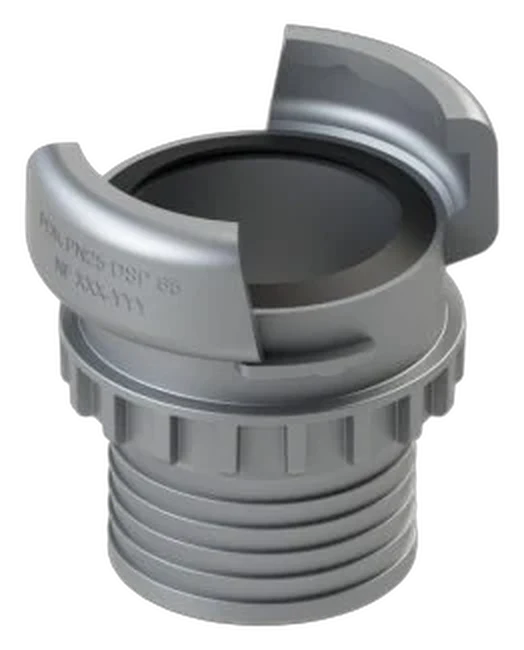
Belgian fire services couple 45 and 70 mm hoses with DSP couplings and 110 mm hoses with AR couplings, with Guillemin as the third permitted type. The Royal Decree of 30 January 1975 lays down these three types for all firefighting installations and equipment, so Storz is not a Belgian type coupling. France also works with DSP and AR. The Netherlands, Germany and Luxembourg use Storz, and the Dutch version with 81 mm lug spacing does not fit the German 89 mm B coupling. An order therefore needs the system and the size, and for Storz the lug spacing as well.
Which coupling each country uses
Belgium and France couple their delivery hoses with DSP and AR. The Netherlands, Germany and Luxembourg use Storz.
| Country | Fire service coupling | Hose diameter (mm) | Source |
|---|---|---|---|
| Belgium | DSP, AR, Guillemin | 45 and 70 (DSP), 110 (AR) | Royal Decree of 30 January 1975 |
| France | DSP 40 and 65, AR, GFR screw coupling in size 20 | 45 and 70 (DSP) | fire service training document (SDIS 63, 2019) |
| Netherlands | Storz with 81 mm lug spacing | 52 and 75 | practice of most Dutch brigades |
| Germany | Storz D, C, B and A | 25, 42 or 52, 75, 110 | hose sizes of DIN 14811 |
| Luxembourg | Storz B and C | 42 or 52, 75 | CGDIS guide, February 2023 |
Apart from the French GFR screw coupling, all these couplings are symmetrical: the two halves are identical, so two ends of the same system and size connect. Between Storz and the Belgian types nothing fits without an adapter. Inside the Storz family the letter alone does not settle it either, as the Dutch row shows.
What the Royal Decree of 30 January 1975 lays down
The Royal Decree of 30 January 1975 lays down three type couplings for firefighting in Belgium, each drawn and dimensioned in its own annex. Article 1 says, in our translation, that installations and equipment for firefighting "must be fitted with couplings that conform to one of the types described in annexes 1, 2 and 3 of this decree".
- Annex 1 describes the "self-sealing symmetrical delivery coupling" in nominal diameters 45 and 70, with or without a locking ring. The trade calls it DSP.
- Annex 2 describes the same kind of coupling as "type A.R.", drawn in the 100/110 size. In nominal diameter 150 it must be interchangeable with the Guillemin coupling of that size.
- Annex 3 describes the "symmetrical coupling (type Guillemin)" for nominal pressure PN 16, in nominal diameters 45, 70, 90, 110 and 150.
All three are specified in cast and anodised aluminium alloy. A copper or stainless alloy is possible by agreement between user and manufacturer.
The decree reaches further than the fire service. A ministerial circular of 9 March 1982 points out that the duty to standardise couplings applies to all natural and legal persons that have firefighting equipment. It names hydrants, the dry and wet risers of buildings and most hydraulic firefighting equipment in industry and buildings. The ten-year period for replacing older couplings ended in 1985. Article 4 makes one exception: the bayonet coupling for the standpipe on underground hydrants of size 80 to the standard NBN 309. For a specific installation, read the text or ask the prevention service of your fire zone.
What fire zones order: the federal sheet TF15
The federal technical sheet TF15 for delivery hoses shows what the decree looks like in a purchase order. The sheet, in its version of 10 April 2017, belongs to a federal contract that was awarded on 28 April 2015 and was valid until 28 April 2019. It pairs hoses and couplings as follows.
| Hose diameter (mm) | Coupling on the sheet |
|---|---|
| 25 (forest fires) | Guillemin |
| 45 | DSP |
| 70 | DSP |
| 110 | AR |
| 150 | Guillemin, Storz as an option |
All couplings on the sheet are in anodised aluminium alloy, and Storz appears on the 150 mm hose only. The supplier named on the sheet is Belgian Fire Safety. That contract has run out, but its pairing of 45 and 70 mm with DSP and of 110 mm with AR is the one in the annexes of the decree.
DSP and AR: the delivery coupling of Belgium and France
DSP and AR are both self-sealing symmetrical couplings, described in annexes 1 and 2 of the decree. What the letters DSP stand for is disputed; the legal name is the one in the decree. Belgium names the sizes after the hose: DSP 45 and DSP 70. French fire service documents call the same pair DSP 40 and DSP 65 and fit them to 45 and 70 mm hoses. A data sheet that reads DSP 40/45 or DSP 65/70 means these two sizes. The decree draws the AR coupling in the 100/110 size, for 110 mm hose. French training material recognises it by its wave-shaped locking ring, which tightens progressively.
The locking ring is the detail to state on every order. The decree draws each half in two versions, with a locking ring and without. A French manufacturer's data sheet states that the ring keeps the halves from uncoupling through pump vibration or a twisting hose, and that at least one half in a joint must have one. On the federal sheet for the semi-heavy pumper (TF06, November 2006) the four 70 mm pump outlets carry DSP couplings without a locking ring. A hose that goes on such an outlet needs a coupling with a ring. Our DSP and AR couplings come as hose couplings, threaded couplings, reducers and blind caps.
Guillemin: the third Belgian type
Guillemin is the third type in the decree, and on the federal hose sheet it sits at the two ends of the size range: the 25 mm hose for forest fires and the 150 mm hose. The decree lists it for PN 16 in five nominal diameters from 45 to 150. Size 150 exists with a locking ring only.
Guillemin is also a common industrial hose coupling, and its pressure rating depends on the version. EN 14420-8 covers Guillemin half couplings with a locking ring for hose assemblies up to 10 bar, for liquids and for solids such as powders and granules. Steam and liquefied gas are excluded. The French standard NF E29-572 of October 2020 covers the half couplings without a locking ring, up to a service pressure of 16 bar. When you order Guillemin couplings, ask for the standard and the pressure rating and compare them with what your pump delivers.
The decree requires interchangeability with Guillemin only for the AR coupling in size 150. For the smaller sizes it describes DSP and Guillemin as separate types. Do not assume that a DSP half and a Guillemin half of the same nominal diameter make a tight joint.
Storz: one name, several lug spacings
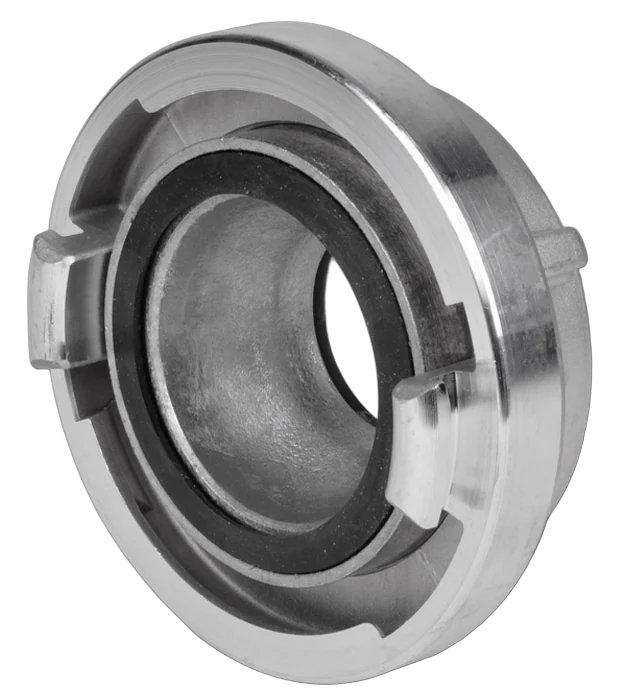
Storz is the coupling of Germany, Luxembourg and the Netherlands, and a Storz size is fixed by its lug spacing. German hoses to DIN 14811 are named after their coupling: D 25, C 42, C 52, B 75 and A 110. The number is the inside diameter in millimetres. The lug spacings published for these sizes are 31 mm for D, 66 mm for C, 89 mm for B and 133 mm for A. Luxembourg follows the German sizes. The CGDIS guide of February 2023 asks for at least two Storz B outlets on an above-ground hydrant and for 42 mm Storz C outlets on every floor of a dry riser.
The Netherlands is the exception. Most Dutch brigades use Storz with a lug spacing of 81 mm on their 52 mm hoses, on their 75 mm hoses and on the fittings, so that everything in the brigade couples together. A Dutch 81 mm Storz coupling does not fit a German 89 mm B coupling without an adapter. Check the lug spacing before you order a Storz coupling for a Dutch brigade, and write it in millimetres on the order. How to measure it is in our article on coupling sizes and how to measure them.
In Belgium Storz is not a type coupling, but it is not absent. TF15 listed it on the 150 mm hose, and in our own range the inline inductors, standpipes, water curtains and suction strainers come with DSP or with Storz. For a customer in the Netherlands or Luxembourg, Storz is the right choice. We supply Storz couplings and coupling keys for Storz and Guillemin.
Mixed sites and border zones: where the adapter belongs
Where two systems meet, the decree's answer is the adapter. Article 2 gave the public fire services two years to hold a sufficient number of adapters for the equipment and installations in the area where they can be called. Article 3 asked the same of private fire prevention and firefighting services, so that their equipment connects to the three type couplings.
Our advice for a Belgian site is to put DSP 45, DSP 70 or AR 110 on every point where the fire zone connects: hydrants, riser inlets, dividing pieces. Equipment that came with another coupling, for example a German-built pump with Storz B outlets, gets a fixed adapter. The zone arrives with DSP hoses. An adapter that sits on the outlet is there when the hose is rolled out; one that lies in a cabinet may not be.
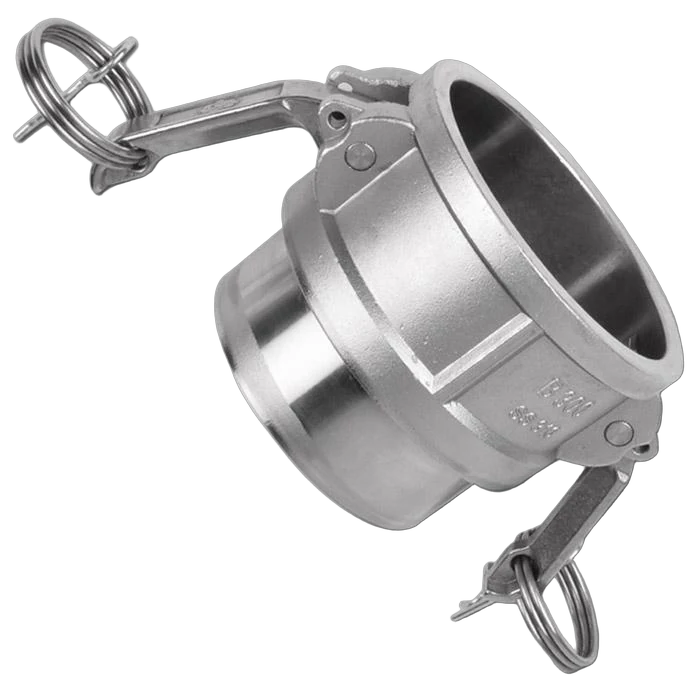
An adapter costs more than its purchase price: each one adds a joint, a seal and a loose part. If you need more than a few, changing the couplings on the hoses is the cleaner solution. Use the right word on the order: a reducer changes the size within one system (DSP 70 to DSP 45), an adapter changes the system (Storz to DSP). Camlock is a transfer coupling for liquids and is not one of the three types in the decree; our article on camlock coupling types explains where it belongs.
For a quotation we need four things per connection: the system, the size (for Storz the lug spacing in millimetres), with or without a locking ring, and the hose diameter or thread on the other side. Send us that list, with a photo if you are unsure. The parts come from our range of couplings. If you are replacing the hoses at the same time, read how to choose a fire hose.
Frequently asked questions
What does DSP stand for?
Sources disagree on what the three letters stand for, so we do not give an expansion. The legal name in the Belgian Royal Decree of 30 January 1975 is "self-sealing symmetrical delivery coupling". The decree describes it in nominal diameters 45 and 70.
What is the difference between a DSP and an AR coupling?
Both are self-sealing symmetrical couplings from the Royal Decree of 30 January 1975. DSP is the coupling in nominal diameters 45 and 70, for hoses of 45 and 70 mm. AR is the 100/110 size for 110 mm hose and has a wave-shaped locking ring. The sizes differ, so a DSP and an AR coupling do not connect directly.
Does a Storz coupling fit a DSP or Guillemin coupling?
No. Storz is a different system from the Belgian type couplings DSP, AR and Guillemin, and the two connect only through an adapter. Name both sides of the adapter with system and size when you order, for example Storz B with 89 mm lug spacing to DSP 70.
Is a Dutch Storz coupling the same as a German one?
Not always. The German C and B couplings have a lug spacing of 66 mm and 89 mm. Most Dutch brigades use Storz with 81 mm lug spacing on both their 52 mm and their 75 mm hoses. An 81 mm coupling does not fit a German B coupling without an adapter, so give the lug spacing in millimetres on every Storz order.